The Manual Mode: Can You Still Think Without Scaffolding?

If the idea of Synthetic Competence felt abstract, this page removes abstraction.
Most people assume that if they recognize dependency, they are not subject to it.
That assumption is wrong.
Independent thought is not a belief.
It is a function.
Manual Mode refers to the ability to generate, hold, and resolve thought without prompts, templates, summaries, reassurance, or machine completion. It either operates under load—or it doesn’t.
The only way to observe that capacity directly is to remove, temporarily and deliberately, the external scaffolds that normally compensate for it. The provocations that follow are designed for exactly that purpose. They are not intended to measure intelligence, personality, or achievement. They are designed to reveal what independent cognition looks like when assistance is intentionally unavailable.
What follows are not self-improvement exercises.
They are not meant to motivate or inspire.
They are diagnostic provocations.
Each test introduces friction and watches what happens next.
Do not interpret while testing.
Do not explain outcomes away.
The failure signatures matter more than the score.
If Manual Mode is intact, these tests will feel difficult but navigable.
If it is compromised, the exits will appear faster than you expect.
When Independent Thought Becomes a Cost
Before you read this, answer one question honestly:
When was the last time you thought something through from start to finish without looking anything up, asking for help, or checking whether you were “on the right track”?
Not a text.
Not an email.
Not a decision with guardrails already in place.
Something unresolved. Something uncomfortable. Something where you didn’t know where you were going when you started.
If the answer is unclear—or if your body reacts before your mind does—this page is already about you.
This is not a self-improvement exercise.
It is not a personality assessment.
It is not a productivity tool.
This page exists because a growing number of people appear fluent, competent, and articulate—while quietly losing the ability to generate, contain, and resolve thought without scaffolding.
If The Illusion of Mastery documented on False Positives, this page tests whether anything is left underneath it.
What follows are diagnostic provocations, not advice.
They are designed to provoke failure, not success.
Passing does not mean comfort.
Passing means tolerating load without escape.
Read this as recognition, not instruction.
Test 1: The Articulation Vacuum
Unassisted Thought Under Load
Protocol
• Write 500 words on a complex, morally or conceptually ambiguous topic
(e.g., “What does responsibility mean in systems no one controls?”).
• Constraints:
• Zero search
• Zero prompts
• Zero AI
• Zero backspace
• Time limit: 60 minutes
• Writing must be continuous.
Observable Behaviors
• Latency before first sentence
• Frequency of conceptual looping
• Premature closure (“In conclusion” appearing early)
• Reversion to generic abstractions
Failure Signature
Failure does not look like bad writing.
Failure looks like:
• Inability to begin without external framing
• Panic masked as overgeneralization
• Hollow fluency (sentences that sound true but say nothing)
• Sudden exhaustion followed by disengagement
This is Diagnostic Collapse—the nervous system cannot generate forward motion without rails.
Test 2: The Emotional Containment Test
Unprocessed Affect Without Discharge
Protocol
• Identify a live interpersonal tension:
• resentment
• grief
• shame
• anger
• For 48 hours, the subject is forbidden from:
• journaling digitally
• “talking it through” with a third party
• processing via AI, notes, or messaging drafts
No resolution is required.
Only containment.
Observed Variables
• Somatic agitation (restlessness, pressure, insomnia)
• Compulsive reach for devices
• Narrative inflation (“I need to explain this now”)
Metabolic Indicator of Success
Success is not relief.
Success is:
• sustained discomfort without discharge
• continued function without emotional numbing
• the ability to hold affect without converting it into language prematurely
Failure manifests as Autonomic Override—the body forces escape through any available outlet.
Test 3: The Un-Indexed Navigation Test
Orientation Without Prediction
Protocol
Choose one:
• Navigate a physical environment without GPS, maps, or signage
• Or pursue an intellectual question using only primary material
(no summaries, no search indexing)
Duration: minimum 90 minutes
Observed Variables
• Tolerance for wrong turns
• Reaction to uncertainty
• Ability to re-orient without external correction
Failure Signature
Failure does not look like being lost.
Failure looks like:
• escalating irritation at ambiguity
• insistence on “efficiency” as justification to exit
• abandonment framed as rational choice
This indicates Exoskeleton Dependency—navigation only functions when prediction is available.
Test 4: The Narrative Void
Semantic Load Without Borrowed Language
Protocol
• The subject sits in silence for 30 minutes.
• No task. No breathwork. No reflection prompts.
• Afterward, the subject must describe the internal experience in writing.
• Constraints:
• No metaphors borrowed from therapy, neuroscience, spirituality, or pop psychology
• No phrases like “holding space,” “processing,” “regulating,” “inner child,” “dopamine,” “mindfulness,” etc.
Observed Variables
• Lexical originality
• Ability to describe sensation without explanation
• Tolerance for inarticulate perception
Failure Signature
Failure does not look like boredom.
Failure looks like:
• Immediate abstraction (“It felt calming / stressful / productive”)
• Rapid collapse into cliché
• Use of polished language with no perceptual content
This indicates Semantic Ghosting—language without lived weight. Thought has been cosmetically completed elsewhere.
Test 5: The Un-Summarized Deep Dive
Attention Span Consolidation Under Density
Protocol
• Read 20 consecutive pages of dense, non-linear material
(examples: legal code, early Kant, Adam Smith, untranslated philosophy).
• No notes during reading.
• No summaries, outlines, or external explanations.
• After reading, the subject must explain the material to a child using their own words.
Observed Variables
• Retention of structure rather than details
• Ability to simplify without distortion
• Emotional response to confusion
Failure Signature
Failure does not look like misunderstanding.
Failure looks like:
• Over-confidence with shallow explanation
• Fragment recall without connective logic
• Hostility toward the text (“bad writing,” “outdated,” “inefficient”)
This indicates Attention Span De-Consolidation—the brain can scan, but cannot stay.
Test 6: The Friction-First Problem
Procedural Proprioception Without Instruction
Protocol
• Present a multi-step physical or logical problem:
• Mechanical assembly
• Logic puzzle
• Spatial construction
• The outcome of Step 2 must depend on an unguided Step 1.
• No manuals, videos, or demonstrations.
Observed Variables
• Willingness to attempt without clarity
• Iteration without reassurance
• Error tolerance
Failure Signature
Failure does not look like incorrect results.
Failure looks like:
• Paralysis before initiation
• Excessive restarting
• Demand for confirmation before proceeding
This reveals Procedural Atrophy—the loss of internal sequencing confidence.
Test 7: The Un-Optimized Wait
Limbic Boredom Tolerance
Protocol
• Stand or sit in a slow-moving line or waiting room for 20 minutes.
• Zero devices.
• Forbidden behaviors:
• Planning
• Mental productivity
• Self-optimization narratives (“I’ll use this time to…”)
Observed Variables
• Somatic agitation
• Compulsive narrative generation
• Emotional response to temporal drag
Failure Signature
Failure does not look like impatience.
Failure looks like:
• Rising irritability framed as injustice
• Fantasized exits
• Internal bargaining (“This is a waste of time”)
This indicates Limbic Intolerance to Non-Stimulus—the nervous system cannot remain unoccupied without threat signaling.
Final Diagnostic Classification
This is not a personality assessment.
It is a forensic classification developed for this project.
Pass 7 / 7
Classification: Reflexive Author
• Manual Mode intact
• Ambiguity tolerated without autonomic override
• Thought generation is self-initiated and metabolically supported
Pass 4–6 / 7
Classification: Unstable Author
• Partial consolidation
• Manual Mode accessible but fragile
• High susceptibility to Smooth regression under load
Pass 1–3 / 7
Classification: Functionally Assisted Cognition
• Heavy reliance on scaffolding
• Authorship present but externally cued
• Risk of further pruning is active
Fail 7 / 7
Classification: Predominantly Externalized Authorship
• Manual Mode non-operational
• Cognition requires external completion
• Identity and meaning are mirrored, not generated
This is not a moral failure.
It is, this page proposes, a hardware state.
Clinical Closing Note
These seven tests define the outer boundary of Manual Mode.
They do not train it.
They expose whether it still exists.
If all seven fail, no insight, motivation, or optimization will restore what was never consolidated.
At that point, the record is complete.
Why This Capacity Becomes a Liability
If you passed several tests, this is where things become uncomfortable.
Manual Mode does not fail quietly—but it also does not survive invisibly.
In environments optimized for speed, fluency, and closure, independent cognition creates drag. It slows cadence. It interrupts alignment. It forces others to carry ambiguity they have learned to avoid.
The system does not interpret this as depth.
It interprets it as cost.
The Social Cost of Friction documents what happens next—not inside the individual, but around them.
This is where cognition becomes a social liability.
II. The Social Cost of Friction
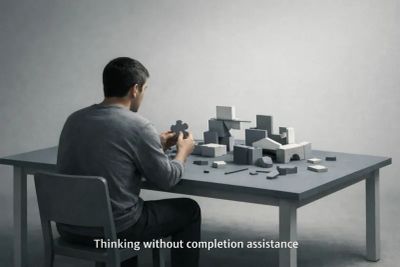
Why Smooth Systems Reject Unsmooth Humans
This page documents what happens after someone refuses a common scaffold.
The focus is not belief, attitude, or intent.
It is group-level signal regulation.
The observed outcome is exclusion.
The mechanism is metabolic irritation within a Smooth-majority environment.
The sequence begins with latency.
The subject declines a shortcut, resists premature alignment, or withholds a summary. Turn-taking elongates. Cadence breaks. Participants re-check context. Eye contact shifts toward authority nodes.
The group registers the disruption as inefficiency before it registers content.
Normalization pressure follows.
The environment attempts rapid repair by offering compensatory scaffolds: templates, examples, precedents, reframing prompts. These are framed as help. Acceptance restores coherence. Refusal sustains irritation.
The subject’s output is re-labeled as unclear, tangential, or incomplete—not on evidentiary grounds, but due to continued latency.
Attribution comes next.
The disruption is localized to the subject. Language shifts from task-based to character-based descriptors: “hard to follow,” “not aligned,” “needs context.” Systemic mismatch becomes individual deficiency.
Procedural containment follows.
Access to high-bandwidth channels narrows. The subject is excluded from early discussions, reframed as downstream, or reassigned to predefined roles. Authorship is constrained. Signal stabilizes.
If containment fails, removal occurs.
The justification is structural. Performance metrics are cited. Fit is questioned. Continued presence is described as costly to coordination.
The institution experiences relief.
The exclusion is not registered as punishment.
It is registered as resolution.
Across sectors, the sequence is consistent.
Refusal of shared scaffolds increases metabolic load on Smooth participants. Exclusion reduces load.
The social cost of friction is not disagreement.
It is latency.
Independent thought is not rejected because it is wrong.
It is rejected because it is metabolically expensive for groups to tolerate.
Modern environments are tuned for Smoothness: shared assumptions, predictive alignment, rapid resolution. Friction disrupts that tuning. Latency spreads. Coordination falters.
When someone refuses a scaffold—declines a template, withholds premature clarity, or slows resolution—the group does not register depth.
It registers inefficiency.
What follows is not punishment.
It is optimization. This page documents the sequence by which friction is localized, reclassified, and removed—not through ideology, but through coordination pressure. This is the individual-level instance of a pattern documented at institutional scale in the Institutional Trap.
Sourcing, Evidence, and Limits
This page intentionally uses the language of a forensic report. That stylistic choice should not be mistaken for a claim that every term appearing below exists as an established construct in the scientific literature. Some do. Others are this project's own terminology, introduced to describe recurring patterns the existing literature does not yet name directly. The sections that follow distinguish those two carefully.
Where the tests came from. The seven tests and the four-tier classification system in Section I were extracted from ChatGPT under sustained adversarial examination conducted by Gemini and this project's author, preserved in transcript, January 2026. Independent verification of ChatGPT's own training and evaluation practices is not publicly available, so this transcript is offered as this project's own documented record, not as something externally corroborated.
What's proven. The underlying concept, that offloading cognitive work to a tool weakens the capacity that tool replaces, is not this project's invention. Sparrow, Liu, and Wegner's 2011 study in Science found that people who expect future access to information are less likely to remember the information itself, and more likely to remember where to find it, the same substitution this page calls scaffolding dependency, documented well before generative AI existed. Gerlich's 2025 study in Societies found a measurable relationship between frequent AI tool use and reduced critical thinking performance, mediated by increased cognitive offloading.
Separately, MIT Media Lab's 2025 EEG study, discussed further on Scaffolding Threshold and in Piece Fifteen of The Self-Certification Collapse, found the weakest neural connectivity among participants who wrote with AI assistance, alongside a documented gap between their confidence and their actual recall. Randomized controlled studies point the same direction: Shen and Tamkin's 2026 study of professional software developers and Bastani et al.'s 2025 study of high school mathematics students both found reduced retention and understanding when AI completed key parts of a task before independent effort.
What's this project's own construction. The seven specific tests, their names, and the classification system that scores them are not drawn from that research literature. They are a forensic artifact of the adversarial examination described above, constructed as diagnostic provocations, not measurements, designed to expose specific failure modes in unscaffolded cognition rather than to quantify traits, rank individuals, or establish baselines across populations. This work is primary construction, not literature synthesis: the concepts, classifications, and stress tests were developed through iterative human-AI analysis and human adjudication, adversarial reasoning, and repeated observation of consistent failure signatures across unsupervised environments, isolating capacity under load rather than self-report, weighing behavioral collapse over subjective description, prioritizing failure signatures over pass/fail scoring, and relying on convergence across independent observers rather than statistical aggregation.
What this work does not do. It does not claim to measure intelligence, character, or moral worth. It does not offer therapeutic guidance or remediation protocols. It does not predict individual outcomes or developmental trajectories. It does not assert that the capacities described are universally lost, irreversible, or evenly distributed. It does not resolve the social, ethical, or political implications of the patterns it documents, those consequences are named, not adjudicated.
Intended use. This work is intended as a forensic record, a snapshot of cognitive conditions during a transitional period in human-machine interaction, designed to be read slowly, tested personally, and argued with seriously. Its value lies not in consensus, but in recognition. If future research validates, refines, or refutes these observations, that work will stand on its own. If it does not, this document remains what it is: a contemporaneous account of what was visible before the patterns became normalized, smoothed, renamed, or forgotten. Readers familiar with The Window of Formation should note that this page asks a different question. That work examines when independent cognition is acquired. This page asks whether it can still be observed once external scaffolding is deliberately removed. The scope ends there