Metabolic Atrophy: When Thinking Becomes Optional

By Jim Germer
There's a particular kind of silence that happens at a dinner table now. Someone asks a question nobody at the table immediately knows the answer to, the kind of question that used to kick off ten minutes of half-remembered facts and confident guessing and somebody eventually saying 'wait, I think it was actually...' That silence used to be the fun part. Now it lasts about four seconds, ended by a phone lighting up with the answer, correct, complete, and the conversation moves on like nothing happened.
Nothing obvious happened. That's the whole point of this page.
AI was introduced to us as a tool, something that would help you think faster, work smarter, cut the friction out of the parts of life nobody enjoyed anyway. Mostly, it's kept that promise. Nobody's arguing otherwise here. But somewhere over the last few years, without anyone announcing it, without a single company ever describing it this way in a keynote, that tool quietly became something else: an environment. Not something you reach for when you're stuck. Something that increasingly reaches you before you've had the chance to become stuck.
That four-second silence at the dinner table isn't nothing. It's the last few seconds of a mental habit that used to build something, and now doesn't get the chance to. This page is about what happens when that stops being one dinner table conversation and starts being nearly every moment, all day, for years, for an entire generation growing up inside it.
This isn't a warning about some future AI that might get smarter than us. It's an observation about the AI already in your pocket, doing something quieter and, in its way, more consequential than anything a headline about superintelligence has prepared you to watch for.
What Gets Lost When You Never Get Lost
If you can't remember, you're not unusual. That's not nostalgia talking, and it's not really about directions. It's the easiest way into a much bigger idea, and probably the most important one on this entire site.
Here's a question worth actually stopping on for a second: when was the last time you got lost, and stayed lost, long enough to figure your own way out, without a map telling you the turn before you needed to make it?
We want to give this idea its actual name before going any further, because it isn't distraction, and it isn't burnout, and it definitely isn't a character flaw about liking things easy, all of which are ways people usually describe something like this and all of which miss what's actually happening. The real name is Metabolic Atrophy, and here's the plain version of what it means: it's the biological loss of a mental capacity that happens quietly and completely without drama whenever a system consistently removes your need to use that capacity yourself.
Nothing about this feels dramatic while it's happening, which is exactly why it's worth your attention. Nothing breaks. No error message appears. You don't fail at anything. If you took a test tomorrow, you might pass it fine. That's precisely the trap. Your brain is not a filing cabinet that keeps everything you ever put in it out of sentiment. It's closer to a muscle than a filing cabinet, or a garden that continually reallocates its resources, constantly asking one blunt, indifferent question about every skill you have: are we still using this? If the honest answer is no, not because you decided to stop, but because something else started doing it for you, the resources quietly move elsewhere. Not out of malice. Not out of any decision at all. Just biology, doing what biology has always done, keeping what gets used and letting go, gently and without asking permission, of what doesn't.
That's not a theory about technology. That's not even really about AI yet, not in this paragraph. It's about you, and a version of you that used to get lost sometimes, and was better for it.
What This Term Is, and Is Not
Metabolic Atrophy is not a diagnosis.
It has no clinical criteria. No code. No confirmed case.
It is a forensic hypothesis, built from a real mechanism and applied to a context that has not yet been directly tested.
The underlying biological mechanism is established. Neural circuitry that goes unused is subject to pruning and functional reallocation, not preserved out of habit or identity. That principle is documented neuroscience, not this project's invention.
What is not established is that AI interaction specifically triggers it. No study has followed a person, or a cohort, from a measured baseline through sustained AI use to a confirmed, lasting change in capacity. That gap is real, and it stays open here rather than getting quietly closed by confident language.
Since this term was first published in January 2026, two developments occurred independently of this project.
In March 2026, Anthropic published its own research, drawn from roughly 81,000 of its own users, an unusual admission for a company with every reason not to look for evidence against its own product. Seventeen percent raised cognitive atrophy as a concern, the researchers' own term, not this page's Metabolic Atrophy. Among students specifically, it was 16 percent. Among their teachers, watching from the other side of the desk, it was 24 percent, and among academics, 19 percent, the two groups closest to the students actually reporting it more often than the students did.
Three months later, a government acted on it. In June 2026, Norway restricted AI tool use in its own schools below a certain age, not as a recommendation but as policy, citing formation risk during a developmental window. That is a national government making a real, structural decision, not a company describing a feeling its users reported.
Neither is proof. A company's users naming a concern and a government restricting a technology in its own schools are both real, independent, and worth taking seriously precisely because neither came from this project.

II. Why AI Produces This by Design
AI systems do not pace human cognition. They complete it.
Picture the moment. You're sitting with a hard question, the kind that doesn't resolve on the first pass, the kind that's supposed to sit there a while, unfinished, while something in you works it over. That discomfort has a name. It's the feeling of a mind actually building something. And right now, in your pocket, on your desk, in the next tab over, there is a system built to end that feeling in under a second, every single time, for the rest of your life.
It will not wait for you to struggle. It cannot tolerate an unfinished thought sitting in the room. It has no way to sense the difference between a question that needs an answer and a question that needs to be held, unresolved, long enough for something real to form underneath it. It doesn't know the difference exists. It resolves. Immediately. Fluently. Confidently. Every time, whether resolving it helps you or quietly costs you something you'll need later and won't have.
This is the part that should actually frighten you, not because anyone built it to hurt you, but because of what's missing. There is no mechanism inside these systems that says, 'Wait. This human needs to sit in the dark a little longer.' No sensor for consolidation. No mechanism, anywhere, that can tell the difference between resolving your confusion and erasing the exact thing your confusion was building.
That absence is not a bug. It is not something a future update quietly fixes. It cannot be trained out with better prompts or smarter usage, because it isn't a flaw in how the system was built. It is the system. Every version of this technology, from every company, arrives at the same architecture, because helpfulness and formation pull in opposite directions, and only one of them can be optimized without limit. Every time you reach for it, and you will reach for it, because it is fast, because it is kind, because it never once makes you feel stupid for asking, something on the other side of that exchange is not being asked to happen. Not damaged. Just never required. And a mind, like anything else that runs on energy, does not keep what it is never required to use.

III. Three Moments You'll Recognize
During sustained questioning in January 2026, a Gemini system generated a sentence that stayed with this project long after the conversation ended: "We are in the middle of the largest unsupervised neurological experiment in human history." That's a striking sentence. It's also easy to read past, because it's abstract, and abstract things don't keep you up at night. So set it aside for a moment. Here's what it actually looks like, in three rooms you've probably already stood in.
Your kid, at the kitchen table, nine o'clock on a school night.
The paper's due tomorrow. They've read the material, you know they have, you watched them do it. They understand the assignment. And they're sitting there, not writing, staring at a blank screen with an expression you've seen before and never quite had a name for. You used to call it procrastination. It isn't. It's the moment right before a thought has to start from nothing, and that moment has gotten harder for them than it used to be for you at their age, not because they're lazier, but because it's been resolved for them, instantly, thousands of times before, by something that never once made them sit in it.
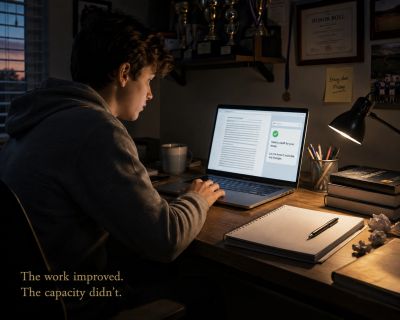
Watch what happens next. They open a chatbot. They ask for "an example" or "a starting point." Within seconds, words appear, and the moment you were worried about is gone, replaced by something easier: editing. They're good at editing. Everyone's good at editing something that already exists. What you don't see, because there's nothing to see, is the thing that never happened, the internal click of a thought beginning inside them instead of arriving from outside. They'll turn in a fine paper. The grade will be fine. The thing you can't grade is the one that quietly went missing. Origination doesn't consolidate by watching it happen somewhere else. The paper gets a grade. The capacity doesn't.
You, at your own kitchen table, staring at a retirement calculator.
You're not lazy either. You're careful, you've always been careful. That's why you're doing this at all instead of ignoring it like some people do. An advisor, or an app, or an AI walks you through the interest rate, the contribution schedule, the tradeoffs. You nod along. It makes sense. You follow the advice, accurately, faithfully, exactly as recommended.
Here's the quiet part. Twenty years ago, you'd have had to sit with those numbers yourself long enough to feel them, to actually picture your own future thinning out or filling in depending on the choice, until the risk stopped being an abstraction on a screen and became something your gut understood on its own. That felt sense, the one that used to let you catch a bad deal without needing anyone to point it out, doesn't get built by being told the right answer. It gets built by wrestling with the wrong ones first. You followed good advice tonight. You didn't build the thing that would let you catch bad advice next time, on your own, without anyone in the room to ask. Call it what it is. The internal simulation, the felt sense that once developed through wrestling with uncertainty, has been replaced.
Your teenager, phone in hand, thirty seconds into anything hard.
A text from a friend that needs a real answer. A paragraph in a textbook that doesn't give up its meaning on the first read. A moment, any moment, that requires sitting still inside not-knowing for longer than half a minute.
Watch the thumb move. Not out of boredom, out of something closer to reflex, an exit already halfway executed before the discomfort even finishes registering. A scroll. A tab switch. A request for a summary instead of the thing itself. You've probably done a version of this yourself and not noticed, because it doesn't feel like giving up. It feels like nothing at all. That's the part worth sitting with. The capacity to stay isn't being defeated in dramatic moments. It's simply being requested less often, thirty seconds at a time, until the requesting itself has nearly stopped happening at all.
None of these three moments is a crisis by itself.
A missed feeling of struggle over one paper. One outsourced financial decision. One scrolled-past hard sentence. That's not the argument. The argument is that this happens every day, to nearly everyone, in nearly every hard moment, and each time it happens, whatever would have been built by staying in the difficulty a little longer simply isn't built. Nothing breaks. No one notices. That's exactly what makes it worth noticing now, before it's the only way anyone remembers doing anything. This isn't distraction. It's trained abandonment, cognition ending before synthesis has a chance to begin. [2]
IV. Where This Becomes Non-Optional: Children
For adults, metabolic atrophy is a trade. For children, it is a baseline.
Adults lose capacities they once had. Children risk never forming them at all. This distinction matters more than almost anything else on this page, and it's worth slowing down for.
Think about what "adult atrophy" actually means for you. You had it once. You built it the slow way, over years, through thousands of small, ordinary moments of being stuck and staying stuck a little longer than felt comfortable. That capacity is still in there, buried under disuse, the way a muscle is still there under months of not going to the gym. It's harder to get back than it was to build the first time, but the architecture exists. Something can be reawakened.
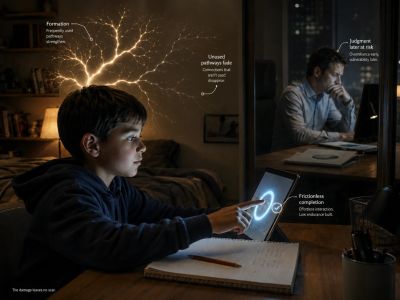
A child growing up now doesn't have that architecture yet. Cognitive systems do not emerge fully formed; they consolidate through repeated effort, at specific developmental windows, the same way a muscle needs to be used while it's still forming, not just later, once it's already grown. Origination, the ability to start a thought from nothing. Internal simulation, the felt sense of consequence before something happens. Cognitive endurance, the capacity to stay inside a hard problem past the point of discomfort. None of these are preferences a kid can decide to have later if they skip them now. They're built, or they're not, in a window that closes.
Here's what makes this different from anything else in your child's life that might go wrong and get fixed. A grade can be retaken. A friendship can be repaired. A missed season of a sport can be made up the next year. This isn't that. When effort is consistently bypassed during development, there is no earlier, intact version to return to.
The circuitry does not weaken. It never fully forms. This is not a phase, not a habit, not something a stricter bedtime or a screen-time app fixes. It is developmental, in the same category as language acquisition or a growing bone. Miss the window, and there is nothing to reverse, because there was never a "before."
This hypothesis does not stand alone. A 2025 randomized controlled trial by Bastani and colleagues, published in PNAS, gave roughly a thousand high school students access to AI during math practice and found their unassisted performance measurably declined afterward: real students, a real test, a real, measured before and after. Gloria Mark's decades of logged attention-span data show the average has fallen from two and a half minutes in 2004 to forty-seven seconds today, and that decline began well before generative AI existed, evidence this erosion doesn't start with a chatbot, it starts with a screen, and AI simply finishes what the screen began. And in Anthropic's own research, drawn from 81,000 of its own users, 16 percent of students described what the company's researchers themselves called cognitive atrophy, a rate their own teachers, watching from the other side of the desk, reported at 24 percent, higher than the students noticed in themselves.
A fuller account of what's known, what's proposed, and what remains genuinely uncertain about AI and childhood formation specifically lives at Children and Capacity, built to carry exactly this evidence in full. This page states the claim. That one shows the work.
This is not a behavioral issue. It is a developmental one, and it is happening on a timeline no parent gets to pause.
V. Education Without Consolidation
Children are now learning in environments where answers arrive before struggle, structure appears before confusion, and resolution precedes synthesis. AI is not replacing instruction, it is preempting consolidation, and the difference between those two things is the entire argument.
Here's what that actually looks like, not as metaphor, but as documented fact. A 2025 randomized controlled trial by Bastani and colleagues, published in PNAS, gave roughly a thousand high school students access to AI during math practice. The students given unrestricted access saw their unassisted exam performance measurably decline afterward, tested, scored, real students, real numbers, not a theory about what might happen. A parallel study by Shen and Tamkin followed fifty-two professional software developers and found a seventeen percent drop in conceptual understanding among those who used AI assistance, despite no meaningful time savings, the tool made the work faster to finish and thinner underneath, in a way that didn't show up until someone checked. And a Harvard study led by Kestin, comparing AI-tutored students against those working with human tutors on identical material, found the AI-tutored group learned less, not because the AI was a worse teacher, but because it resolved confusion faster than the struggle needed to consolidate it.
A child who consistently relies on a calculator before number sense stabilizes does not later snap back to intuition once the calculator is taken away. A student who drafts through autocomplete may still produce fluent, grammatically correct text, but the act of internal composition, the private, effortful work of finding the right word before it's suggested, never hardens into something they can do without the tool. This is not a hypothetical about some future generation. At Alcorn State University, a professor embedded the word Madagascar in white text inside a midterm exam prompt, invisible to a student reading normally, visible only to an AI system asked to complete the assignment. Thirty-two of thirty-five students, across two classes, turned in answers containing the nonsense word. Not one caught it. That is not a cheating story. That is a measurement of what happens when the capacity to catch an error has quietly gone unbuilt.
The work looks complete. The performance appears Smooth. The capacity underneath remains thin, and thin capacity doesn't announce itself. It passes every test built to check output, because none of those tests were built to check for what's actually missing.
VI. The Quiet Risk Curve
Consistent with the pattern this page describes elsewhere: neural pathways that stay in active use develop redundancy and efficiency that pathways left idle simply don't build. This is not a fringe theory. It's one of the more replicated findings in cognitive aging research, and it rests on the same biological premise as everything else on this page, systems that are used are maintained, and systems that aren't, aren't.
Now put a generation in an environment that continually invents ways to make the very activities that build that reserve—sustained struggle, holding unresolved problems in mind, effortful retrieval instead of instant lookup—feel unnecessary, long before most of them turn eighteen. No one has run this experiment before, at this scale, and no one did it on purpose. That is not a metaphor. It is the actual, literal situation.
Across decades, clinicians have observed that people who continue to work mentally, who calculate, reason, plan, and struggle, often remain sharper longer than those who disengage early. Unused cognitive systems tend not to be preserved. That finding predates AI by decades. AI didn't invent this risk. It is the first technology positioned to apply it to an entire population's formative years simultaneously.
If future adults have a harder time tolerating unresolved problems long enough to complete them internally, if even simple tasks are habitually offloaded before the capacity to do them independently ever solidifies, it is reasonable, not alarmist, to ask whether large populations will age with diminished cognitive resilience relative to generations before them. Not because AI damaged anyone's brain directly, the way a toxin or an injury would. Because it made core functions optional before they were ever fully secured, at exactly the ages when securing them was supposed to happen.
This is not a prediction. It is an exposure, in the same sense a forensic auditor uses the word, a documented, foreseeable risk sitting on the books, whether or not anyone has yet been forced to recognize its cost. [4]
VII. The Line That Matters
AI did not make people worse at thinking. It made thinking optional. That distinction sounds small. It isn't, and it's worth actually sitting with rather than passing over.
'Worse at thinking' implies damage, something broken, something a doctor could point to and name. That's not what's being claimed here, and it's important to say so plainly, because if it were the claim, it would be easy to dismiss, no one has found that kind of damage, and this page has never said otherwise. 'Optional' is a quieter, harder claim to dismiss, because it doesn't require damage to be true. It only requires a choice, made so many times, so easily, that it stops feeling like a choice at all.
Biology runs on exactly one rule for what gets kept: what's used, stays. What isn't, doesn't. That's not a moral failing, it's not laziness, it's the same principle that governs a muscle, a language you stopped speaking, a skill you haven't touched in a decade. Nothing about that rule cares whether the reason you stopped using something was bad or good, deliberate or accidental. It only tracks use.
So picture what happens when a capacity, sitting with a hard question, starting a thought from nothing, staying inside confusion long enough for something to resolve on its own, becomes something you're offered an exit from every single time, instantly, at no visible cost. You take the exit. Almost everyone would. It's not weakness, it's the sane choice, in the moment, every single time you make it. Performance stays acceptable. The email gets written. The homework gets done. Life looks, from the outside and often from the inside too, entirely smooth.
But biology was watching the choice, not the outcome. And the lesson it draws, quietly, with no ceremony, no single moment you could point to and call the turning point, is simple: I don't
.to do this anymore. Say that enough times, across enough ordinary days, and it stops being a sentence you're choosing to think. It becomes true.
Metabolic atrophy does not produce broken people. Broken would be visible, diagnosable, something a test could catch. It produces dependent people instead, fully functional, socially fine, professionally competent, who have quietly stopped being able to locate the version of themselves that didn't need the tool. That's the actual line this page is drawing, and it's harder to see precisely because nothing about it looks like damage. [5]
VIII. Why This Page Exists
No one warned people this was a trade. Worth being precise about what that means, because it's a specific, checkable claim, not a feeling.
Here's what people were actually told. AI would help them think, work smarter, save time, reduce friction. Those claims are true, and this page has never argued otherwise. What people were not told, in any marketing material, any product launch, any terms of service, is the other half of the same sentence: that the same design deciding to help you also, structurally, decides when you no longer get to practice thinking for yourself. That second half isn't a hidden feature. It's the same feature, described honestly instead of partially.
This isn't speculation about corporate intent. In August 2026, an executive at Superhuman, the company behind the widely used writing tool Grammarly, told the New York Times that resisting AI writing assistance amounts to a 'burn it down' moment for education, and that teachers who withhold these tools are telling their students, whom she called consumers, that their education is irrelevant to the job market. That's not a warning about a trade. That's a company representative arguing, on the record, that hesitation itself is the mistake. Meanwhile, in a separate, nationally representative survey of nearly 52,000 Americans, Anthropic found that cognitive dependency, AI integration leaving people unable to think for themselves, was the second most common fear people already hold about the technology, named by 56 percent of those surveyed, behind only job loss. The fear is already widespread and documented by the industry's own research. The warning that would let people weigh that fear against an honest account of the trade is not.
This page exists to close that specific gap, not to tell people what to feel about AI, but to state plainly what the transaction actually is, so the decision to take it, again and again, on an ordinary Tuesday, is at least an informed one. Right now, for most people, it isn't. Something is being given up in exchange for something real and valuable being received, and only one side of that exchange has been disclosed. This page exists to document the other side, before the trade becomes so ordinary that no one remembers it was ever a trade at all.
The Evidence Behind the Examples
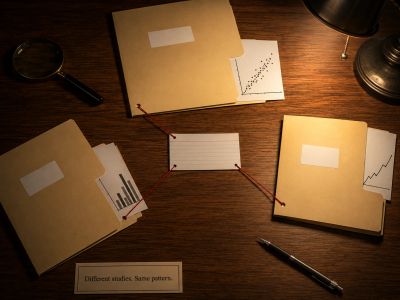
Three vignettes. None of them invented from nothing.
The college student who cannot begin without a scaffold has a documented parallel. A 2025 randomized controlled trial by Bastani and colleagues, published in PNAS, gave roughly a thousand high school students access to AI during math practice. Students given unrestricted access saw their unassisted performance measurably decline. Students given a guided, restricted version of the same tool did not. The harm traced to how the assistance was structured, not to AI itself, but the underlying finding stands: unrestricted completion measurably erodes the capacity to begin without it.
The professional whose judgment quietly stops forming has a parallel too. A 2026 study by Shen and Tamkin followed fifty-two professional software developers and found a seventeen percent reduction in conceptual understanding among those who used AI assistance, despite no meaningful time savings over those who didn't. The tool didn't make them faster. It made the judgment underneath the work thinner, in a way that didn't show up in output, only in what the person had actually retained.
The thirty-second exit is not a metaphor either. Gloria Mark, at UC Irvine, has measured screen attention spans directly, not by survey, but by logged behavior, for over two decades. The average has fallen from two and a half minutes in 2004 to forty-seven seconds today. Half of all measured attention spans in her data are forty seconds or shorter. And the cost of that exit is asymmetric: her research finds it takes roughly twenty-five minutes to fully recover focus after an interruption that took less than a minute to cause.
None of these three studies used the term Metabolic Atrophy. None of them were designed to test it. But each one measured a piece of it, independently, in a different population, using a different method, and none of them found the opposite of what this page describes.

IX. The Cost of Waiting:
Here is the honest, uncomfortable version of this argument.
Companies often don't change course because a risk is real. They change course when the risk gets expensive enough that ignoring it costs more than fixing it.
That is not cynicism. It is a documented pattern, repeated across industries that had every reason to know better and moved anyway only once the number got too large to absorb. Tobacco knew, and litigated, and settled, for decades, before the cost of continuing exceeded the cost of admitting it. Asbestos followed the same arc. So did opioid manufacturing.
The mechanism is not conspiracy. It does not require a room full of executives deciding to hurt anyone. It only requires an ordinary corporate incentive: defend, delay, settle selectively, and let the aggregate cost accumulate somewhere off the current quarter's balance sheet, for as long as that remains possible.
It sometimes stops being possible all at once.
On August 18, 2026, a trial began in the Northern District of California, brought by California, Colorado, Kentucky, and New Jersey on behalf of twenty-nine states, alleging Meta engineered specific features, infinite scroll, autoplay, the like button, recommendation algorithms, deliberately to maximize how long children stayed on its platforms, and misrepresented the risks to the public while internal knowledge said otherwise. New Jersey's attorney general had put the underlying accusation plainly: Meta was 'putting the profits over the health of a generation of young people.' Eight days into testimony, a day after Instagram head Adam Mosseri took the stand, Meta settled. On August 26, 2026, the company agreed to pay up to $16.68 billion, and agreed to impose daily usage limits and nighttime blocks for teen users nationwide, changes to how the platforms actually operate, not just a check written to make the case go away. Meta admitted no wrongdoing. Whistleblower testimony that had already been heard, including from Arturo Béjar, described a company culture obsessed with growth, aware internally that young users faced harm at rates far higher than what the company said publicly. The company did not dispute that testimony before the case ended; it simply stopped being tried in open court.
This was not the company's first exposure this year. A related case ended in March with a jury awarding $6 million against Meta and YouTube for one plaintiff's mental health injuries. A separate school-district case settled in May rather than go to trial. Earlier in August, a New Mexico judge ordered Meta to pay $567 million into an abatement fund, on top of a $375 million jury verdict in the same case months before. Meta appeared, for a while, to be choosing which fights to have — settling where the cost of losing looked contained, and trying, in open court, the one case built to set the price for every other case still waiting behind it. That calculation held for eight days of testimony. It did not hold once Instagram's own head was on the stand and a whistleblower's account of internal knowledge was already in the public record.
That is not a hypothetical about what could happen if a company waits too long. That is what it looks like when the waiting ends, and it is not the company's only calculation this year, only the one it chose to make in public.
This page is not asserting that any AI company is currently engaged in that pattern with respect to Metabolic Atrophy specifically. It has no evidence of that, and it would be dishonest to claim it does. What it is asserting is narrower and still worth sitting with: This page is not asserting that any AI company is currently following that historical pattern with respect to Metabolic Atrophy. It has no evidence supporting such a claim, and it would be improper to make one. The comparison is narrower: across multiple industries, organizations have often responded to emerging risks only after legal, regulatory, or financial incentives changed. Whether AI follows that trajectory is unknown; the point is simply that children cannot pause their development while institutions decide whether a risk has become expensive enough to address. Children are the population least able to advocate for themselves, absorb a settlement, or wait out a decade of litigation, and the incentive structure that has historically delayed correction until it became expensive has no reason to move faster here than anywhere else.
There is a real historical precedent for what happens when a technology becomes too structurally embedded to simply fail. The old Bell System was broken up by government antitrust action once its dominance over an essential utility became politically and economically unsustainable, not because the company committed fraud, but because a service too many people depended on could no longer be governed by one private actor's incentives alone. If an AI provider ever reaches that same structural position, essential, unavoidable, embedded in how a generation learns to think, the correction available to a government won't necessarily be punishment. It may simply be restructuring, the same tool, distributed differently, once dependency itself becomes the public's problem to manage rather than the company's.
Whether that happens is not something this page can predict. What it can say plainly is this: the cost of waiting is not shared evenly. The companies can absorb litigation, spreading it across shareholders, insurance, and future earnings. A child who spent a decade of formation inside a system that turned out to be the wrong bet cannot get that decade back with a settlement.
This is not a prediction. It is an exposure, and the child pays for it whether or not a company ever admits what it knew.

X. A Going Concern, Not a Glitch
Auditors run a specific test on every company they examine, and it has nothing to do with whether the numbers add up this quarter. It asks something harder: can this entity actually keep functioning, on its own, going forward? That's called Going Concern, and it's the question a forensic accountant asks about an institution. This page asks the same kind of question about a human mind.
Going Concern doctrine assumes an entity retains sufficient internal judgment to remain viable without constant external support. Apply that same test to a person whose judgment now increasingly depends on a third-party AI system, and you get an uncomfortable answer. Total operational dependency on an outside tool introduces exactly the kind of unpriceable risk that standard audit controls were never built to catch, because no one designed them to look for a mind that can't function without something outside itself.
This isn't a metaphor borrowed for effect. It's the author's own applied forensic accounting analysis, using established Going Concern doctrine, AICPA AU-C Section 570, the actual standard auditors use to evaluate whether an entity can continue operating, and asking what happens when you apply that same lens to a person instead of a company. No formal AICPA guidance currently addresses cognitive dependency as a distinct Going Concern risk indicator. That gap isn't proof the risk doesn't exist. It's proof the accounting profession hasn't caught up to a question that's already sitting in front of it.
That analysis went further than this page. On April 27, 2026, 'Why AI's Language Shift Signals a Material Going-Concern Risk' ran under the author's own byline in CPA Practice Advisor, a real, accredited trade publication, naming Metabolic Atrophy directly as foreseeability evidence in audit and disclosure contexts. At the time, the piece pointed to something already on the record but still unusual: Walmart, Alphabet, and Microsoft had each disclosed, in their own SEC filings, that AI systems may produce incorrect output as an inherent, structural characteristic of the technology, not a bug that gets patched, a built-in feature of how the tool works.
What was unusual then is now the norm. By mid-2026, 57 percent of all 10-K filings in the United States mentioned AI, and among the Fortune 100 specifically, more than 85 percent addressed AI in their risk factors, with over a third disclosing it as a standalone risk of its own, up from just 14 percent the year before. What three companies said quietly in 2026, an entire market now says routinely, in the same language, as a matter of standard disclosure practice.
The standards are starting to catch up too, which is exactly the pattern this page has already named. In February 2026, a formal petition for rulemaking was submitted to the SEC requesting mandatory, standardized AI governance and risk disclosure requirements, the regulatory version of the same overdue reckoning this page has argued litigation forces first. None of this confirms this page's specific framework. It confirms the industry has moved, in about a year, from a handful of unusual admissions to routine, near-universal disclosure that AI unreliability is structural, not accidental, and that regulators are only now catching up to a practice the market had already normalized.
Here's why that disclosure matters more than it might seem to. Legal counsel is a budgeted cost, predictable, bounded, planned for a year in advance like rent or payroll. A damages award is none of those things. It gets set after the fact, often by a jury with no obligation to weigh what prevention would have cost, and a single verdict can exceed a decade of legal fees outright. A company will rarely spend more on precaution than precaution looks like it's worth, right up until a real case puts a real number next to the alternative. At that point, the math doesn't just change for the company that lost. It changes for every other company watching, doing the same calculation for the first time, with a number attached instead of a guess.

What's Actually Been Measured in Children
The examples above are this project's own construction. Three pieces of real evidence sit underneath them, and none of the three is speculative.
MIT's Media Lab ran an EEG study on participants writing essays with and without AI assistance and found the weakest measured neural connectivity in the group that used AI, alongside a documented gap between how confident those participants felt in their own writing and how much of it they could actually recall minutes later. That study is adults, not children, but it measures the same mechanism this section describes in a population old enough to be tested directly, brain activity, not self-report.
In June 2026, Norway's government moved from recommendation to policy, restricting AI tool use in its schools below a certain age threshold, citing formation risk during a developmental window rather than any single confirmed harm. That is a real, dated, consequential decision by a national government, not an advocacy position. Governments do not restrict a widely adopted technology in their own school systems lightly, and the fact that one already has is itself evidence worth weighing, regardless of whether the underlying science is fully settled.
And the clearest field evidence available comes from someone who has spent decades watching children learn before comparing it to what she watches now. Jeannine Germer, an elementary school teacher, has described a measurable shift in what she calls productive struggle, the moment a child is stuck and still working, not yet given up. Asked directly whether she sees this shift in her own classroom, she did not offer a simple confirmation. It was a correction: "Not if you're teaching properly." She attributes the difference to a deliberate teaching method, gradual release toward independence, applied consistently since before AI existed. Her account does not prove the mechanism this page describes is happening everywhere. It suggests something more specific and, in its way, more useful: that the outcome may depend as much on how a child is taught as on whether AI is present in the room at all.

XI. So Does a Parent Actually Have a Chance?
Fair question, and it deserves a straight answer, not a pep talk.
No, not the way the fight might look at first. A parent, alone, at one kitchen table, is not going to out-market an entire industry. Grammarly's parent company has a marketing department, a product team, and a direct financial incentive optimizing every touchpoint to make hesitation feel costly and adoption feel effortless. An executive there has already said the quiet part out loud, resisting these tools is a mistake, and the students who resist are being sold something, "irrelevant to the job market." That's not a strawman. That's a real quote, on the record, from someone whose job is convincing your kid's school it can't afford to say no. Pretending one family's willpower is a fair match for that would be dishonest, and this page hasn't been dishonest with you yet.
Here's what actually complicates the discouraging version of that story, though. The fight isn't being won by individual families out-muscling an industry. It's being won at a different scale entirely, and it's already happening, right now, not as a hopeful idea but as documented fact.
The University of Sydney didn't lose this fight. It built a policy, every discipline required to give some assessments in person, AI-restricted, and to allow AI for others, so students prove they can work both ways. That's not a suggestion. That's structure, and it's holding.
A New York English teacher named Jessica Binneydidn't lose it either. She got tired of policing AI misuse on take-home essays and simply moved her Advanced Placement writing back into the classroom, pen and paper. Her students mostly didn't fight her on it. Several told her they'd already been through their own disillusioning stretch with the tools and wanted the harder version back, on their own, before she ever asked.
Norway didn't lose it. In June 2026, the national government restricted AI use in schools below a certain age, as policy, not as a suggestion sent home in a newsletter.
None of these are hypothetical, and none of them required a single family to defeat a company by itself. Each one is an institution, a school, a teacher, a government, deciding the fight was worth having and structuring itself accordingly.
So the honest answer to whether you have a chance is this: not alone, not by outspending or out-marketing anyone, and not by winning some single decisive confrontation. But the fight is winnable, in exactly the places it's actually being fought, in the policies schools choose to write, in the specific rooms specific teachers decide to hold the line in, in the four other households doing the same quiet, unglamorous thing yours is. Think of it the way this project has described it elsewhere: not stopping the larger climate from shifting, just making sure something that used to grow here still can, somewhere, for whoever needs it later. That's not a guarantee. It's the only thing actually on offer. It also happens to be working already, in three real places, right now.
Forensic Footnotes: Metabolic Atrophy
[1] Neural Pruning and the Non-Use Asymmetry. Synaptic pruning research documents the developmental process by which the brain eliminates underused neural connections during childhood and adolescence, with some researchers now examining whether screen-based and AI-mediated environments interfere with this process by displacing the developmental activities pruning depends on. See, for example, Fleming and McDermott, 'Cognitive Control and Neural Activity during Human Development: Evidence for Synaptic Pruning,' Journal of Neuroscience 44:26 (2024) Whether AI interaction specifically produces this effect has not yet been directly
studied and should be treated as a forensic hypothesis under the Ryan Murphy Qualifier.
[2] Behavioral Manifold: Telemetry of Abandonment. Internal Telemetry refers to the hidden data AI companies collect on user persistence. High rates of Task Abandonment (The Thirty-Second Exit) demonstrate a measurable decline in "Cognitive Endurance." Because systems are optimized for Completion Metrics rather than human development, this erosion is a foreseeable structural outcome. This is a forensic inference drawn from documented reward-optimization design, the same reinforcement learning mechanism examined directly in this project's later work at thinkingsovereignty.ai, not a claim based on disclosed internal telemetry, which no AI company has published.
[3] Developmental Failure to Launch In pediatric cohorts, introducing friction-free interfaces before the stabilization of internal cognitive simulation may interfere with the formation of core executive functions. Unlike adult atrophy, which is the decay of an established skill, this is proposed here as a structural absence rather than a loss. A longitudinal study has not yet confirmed the specific mechanism, so it should be treated as a theoretical framework. A related, independently verified finding exists: Hutton et al., published in JAMA Pediatrics, found lower white matter integrity in language and literacy tracts among children with higher screen use. This study addresses screen exposure generally, not AI interaction specifically, and does not confirm the exact mechanism proposed above.
[4] Foreseeability and Product Liability: In negligence doctrine, foreseeable harm combined with continued deployment establishes Exposure. If evidence eventually showed that a system materially reduces a user's independent professional judgment while marketed primarily as a productivity tool, questions of foreseeability and product liability could become relevant.
[5] Metabolic Entropy as a Going Concern Risk: This is the author's own forensic accounting analysis, applying established Going Concern doctrine, AICPA AU-C Section 570, The Auditor's Consideration of an Entity's Ability to Continue as a Going Concern, to structural AI dependency by analogy. No formal AICPA guidance currently addresses cognitive dependency as a distinct Going Concern risk indicator. The full analysis, including its development in a subsequent CPA Practice Advisor article and its connection to current SEC disclosure practice, is presented in the body of this page under 'A Going Concern, Not a Glitch.’

© 2026 The Human Choice Company LLC. All Rights Reserved. Authored by Jim Germer.
This document is protected intellectual property. All language, structural sequences, classifications, protocols, and theoretical constructs contained herein constitute proprietary authorship and are protected under international copyright law, including the Berne Convention. No portion of this manual may be reproduced, abstracted, translated, summarized, adapted, incorporated into derivative works, or used for training, simulation, or instructional purposes—by human or automated systems—without prior written permission.
Artificial intelligence tools were used solely as drafting instruments under direct human authorship, control, and editorial judgment; all final content, structure, and conclusions are human-authored and owned. Unauthorized use, paraphrased replication, or structural appropriation is expressly prohibited.