Education After AI

The Difference Between Completing and Learning
By Jim Germer
There’s a comforting lie most of us still carry about education. We tell ourselves the system exists to build capacity. To teach students how to think. To prepare them for life. And on a good day, it does. But structurally, modern education has always existed to do something else first: credential production. Process students through a pipeline. Issue degrees that signal competence. Keep the system running. For decades, that worked well enough. Even when the system was optimized for completion over formation, enough friction remained that students still built capacity. You couldn’t get through school without writing, without struggling, without thinking. AI removes that friction systematically. And once friction is gone, the system reveals what it always was: a credential pipeline that is losing its connection to the capacity it was built to represent.
A fuller evidentiary record for the argument that follows, including the underlying studies, their sourcing, and their honest limits, is available at Children and Capacity.
I. My Wife’s Classroom
My wife Jeannine is an elementary school teacher. She’s 61. She still teaches kids how to write essays. Not how to prompt AI. Not how to “collaborate with AI.” How to build an argument from scratch.
She’s in the minority now. And she knows it.
Most of her colleagues have quietly accepted that “the future of education” means teaching students how to use AI tools effectively. How to prompt. How to verify outputs. How to “augment their thinking.”
But Jeannine has watched what happens when students skip the hard part. She’s watched what happens when the scaffolding becomes permanent. She’s watched what happens when a child never has to hold on to uncertainty long enough for an answer to emerge.
And what she’s seeing isn’t “augmented thinking.” It’s metabolic atrophy.
What Formation Actually Looks Like
When a third-grader sits down to write a paragraph about their summer vacation, something crucial is supposed to happen. The child is supposed to sit with “I don’t know what to say yet.” They’re supposed to feel the discomfort of a blank page. They’re supposed to start with a bad sentence, realize it’s bad, and try again.
That friction — that cognitive discomfort — is not a bug in the learning process. It’s the entire point. Because sitting with “I don’t know yet” is how the capacity to think gets built. The struggle is the training.
But when the child takes a photo of the assignment, AI generates three perfect sentences, and the child copies them onto the page, none of that happens. The output arrives. The assignment gets completed. The teacher — if they’re not paying close attention — sees neat handwriting and complete sentences and assumes the child is learning.
The child isn’t learning. The child is completing.
And completion is not formation.
What Jeannine Can Still Do
Jeannine can still tell the difference. She can read a sentence and immediately know whether a child wrote it or an AI did. Not because she’s looking for technical tells, but because she knows what an eight-year-old voice sounds like. She knows the rhythm of a child’s thinking. She knows what authentic struggle produces.
Thanks to Florida’s DROP program — a deferred retirement option that allows experienced teachers to continue working while deferring their pension — she’ll be in that classroom for years to come. The students who have her still have something most students won’t: a teacher who built her baseline before AI existed and can demonstrate what that looks like.
The teachers who will eventually replace her weren’t given what she had. Not because they’re bad teachers. Because many of them used AI throughout college, they never built the baseline to compare against. They don’t know what authentic student voice sounds like because they never fully developed their own.
The Part Nobody Is Saying Out Loud
It’s not just students losing capacity. It’s teachers.
The next generation of educators — the ones entering classrooms right now — cannot teach what they never learned. They cannot model thinking they never practiced. They cannot give feedback on writing they never mastered.
That’s not a criticism of their character. It’s a description of the formation environment they moved through, which failed to provide.
And once teachers like Jeannine are gone, who teaches the children how to think?
Not AI. AI can generate outputs. But it cannot demonstrate the struggle of thinking. It cannot model what it looks like to sit with uncertainty, to revise a weak argument, to tolerate the discomfort of not knowing yet.
Not AI-dependent teachers. They never saw that struggle themselves.
The question isn’t rhetorical. Under current incentives, the system has no clear structural answer to it.

II. This Is Worse Than Snowflake
People use the term “snowflake” to describe this generation. Too sensitive. Too fragile. Can’t handle criticism. Can’t tolerate discomfort.
But that diagnosis misidentifies the problem.
Because “snowflake” implies the person could toughen up if they wanted to. It implies the capacity exists but isn’t being used. It implies this is a choice — a moral failing, a character weakness.
It isn’t.
This is worse than snowflake.
This is what happens when the capacity was never built in the first place.
What Essay Writing Actually Builds
When a child learns to write an essay, they’re not just learning to put words on a page. They’re learning to hold uncertainty. They’re learning to sit with “I don’t know what I’m trying to say yet” long enough for the argument to emerge. They’re learning to tolerate the discomfort of a bad first draft. They’re learning to revise — which means confronting the gap between what they meant and what they wrote.
That process is metabolically expensive. It burns cognitive calories. It creates frustration. It requires the nervous system to handle friction without collapsing.
And that friction builds capacity.
But when AI does that work — when the child goes straight from “I need to write about the Civil War” to a perfectly formatted five-paragraph essay — the friction is removed.
The output still arrives. The grade still comes. The assignment is still completed.
But the capacity is never built.
Not suppressed. Not hidden. Not avoided. Never formed.
The Distinction That Matters
You can tell a “snowflake” to toughen up. You can criticize their choices. You can demand they try harder.
But you cannot ask someone to access a capacity that was never developed. You cannot tell them to “use the muscle” when the muscle was never built.
That’s not sensitivity. That’s structural absence.
The distinction matters because the diagnosis determines the response. If the problem is character, the solution is motivation — push harder, choose differently, want it more. But if the problem is structural absence, motivation is irrelevant. You cannot will into existence a capacity that the formation environment never produced.
This is why the snowflake diagnosis, however satisfying, consistently fails to generate solutions. It’s aimed at the wrong target.
What AI Completed
When students grow up in environments where every source of friction — every moment of “I don’t know,” every experience of “this is hard,” every period of unresolved uncertainty — is treated as a system failure to be optimized away, the result isn’t a generation of snowflakes.
The result is a generation with a missing baseline cognitive infrastructure.
Not weak. Incomplete.
The difference is architectural. A weak structure can be reinforced. A missing structure has to be built from scratch, which requires the friction that the formation environment no longer provides.
AI didn’t introduce this problem. Credential-focused education was already optimizing for completion over formation before AI existed. But AI accelerated the mechanism, making the substitution invisible.
AI didn’t create the gap. AI completed it.
Students are starting to say this themselves, in almost exactly these terms. Ainsley Graham, a high school junior interviewed by the New York Times, described using AI to write essays about literature this way: 'You're not strengthening that muscle by actually analyzing these really hard texts. They're meant to be hard.' Another student at the same school, Cassady Tondorf, put it differently but landed on the same problem, watching AI produce her classmates' writing convinced her chatbots have no real originality: 'The entire internet is open to it. It's just regenerating the same things, over and over.' Neither student had a name for what they were describing. They didn't need one to notice it happening.
III. The Elementary School Failures
Let me show you what this looks like in practice. Three examples. All happening right now in classrooms across the country.
Three different subjects. Same structural pattern. Output looks fine. Capacity doesn’t build. The gap doesn’t become visible until years later, when the environment changes, and the scaffolding isn’t there.
The Reading Comprehension Mirage
Teacher assigns: “Read this chapter and write three sentences about what you learned.”
The student uses a phone camera. AI reads the page. AI generates three sentences. The student copies them. Turns it in. Gets an A.
The teacher sees clean handwriting, complete sentences, and accurate content. Evidence that the child “read and understood.”
What actually happened: The child never read the page. Has no idea what the chapter was about. Didn’t practice summarizing. Didn’t build reading stamina. Learned instead that reading is optional when AI can produce the output.
By third grade, the child struggles to read a full chapter without an AI summary. By fifth grade, anything longer than two paragraphs produces avoidance. By middle school, the child is “reading at grade level” according to standardized tests — but has never independently read a book without AI assistance.
The teacher doesn’t catch it because the output is clean. Basic comprehension questions get answered — AI provided the answers. Standardized reading tests reward pattern recognition rather than deep comprehension. The feedback loop that should detect the gap never closes.
The Math Understanding Illusion
Teacher assigns: “Show your work. If Sarah has 24 apples and gives one-third to her friend, how many does she have left?”
The student photographs the problem. AI generates a step-by-step solution. The student copies the steps. Turns it in.
The teacher sees the work shown, the correct answer, and properly formatted steps. “The child understands fractions.”
What actually happened: The child doesn’t understand what one-third means. Can’t do the division. Copied symbols without comprehending them. Never built number sense.
By fourth grade, mental math is unreliable. By fifth grade, the child can’t estimate whether an answer is reasonable. By sixth grade, the child is “at grade level”—meaning they can follow AI’s procedure—but has no mathematical intuition underlying it.
Remove the AI and the calculator. What remains is a child who is functionally innumerate — not because they lack capability, but because the formation work was routed around before the capacity could develop.
The teacher doesn’t catch it because the homework is always perfect. AI often produces correct arithmetic outputs without visible struggle. The child can recite memorized procedures in class but can’t transfer them to novel problems. Standardized math tests reward procedure-following. Reasoning isn’t measured.
The Creative Writing Extinction
Teacher assigns: “Write a story about your summer vacation. Use descriptive words.”
Student prompts AI: “Write a story about summer vacation at the beach.”
AI generates a structured narrative with vivid descriptions. The student submits it.
The teacher sees vocabulary richer than the child usually produces and reads it as growth. Proper paragraph structure. Clear beginning, middle, and end. “This child is developing as a writer.”
What actually happened: The child never practiced generating ideas. Never struggled with word choice. Never learned to revise. Never built the stamina to sit with “I don’t know how to say this.”
By second grade, writing a sentence from scratch without AI produces paralysis. By fourth grade, the child has no voice — everything sounds like AI because AI produced everything. By fifth grade, in-class writing assignments cause the child to freeze. The muscle was never built.
The child appears to be a strong writer — take-home grades are high — but cannot produce original thought under independent conditions.
The teacher doesn’t catch it because AI-generated stories often exceed what the teacher expected from that child. Polish gets read as progress. In-class writing is infrequent — it takes time to assign and time to grade, and students resist it. When in-class writing reveals the gap, the explanation is usually “test anxiety,” not a lack of capacity.
The Pattern Across All Three
Three subjects. Three different teachers. Three different feedback loops.
Same result: the output metric stays green while the formation metric — rarely measured — declines.
The assessment structure in each case was designed for a world where completing the work and doing the work were the same thing. In that world, a perfect assignment meant a child who practiced the skill. The output was evidence of the process.
AI severs that connection. The output arrives without the process. The evidence remains. The formation doesn’t.
By the time the gap becomes visible — in middle school, in high school, in a job that requires the skill — the window for building the baseline has narrowed significantly. The earlier the substitution starts, the longer it compounds before anyone sees it.
That’s not a teaching failure. That’s an assessment structure operating exactly as designed in conditions it wasn’t designed for.
IV. The Parent’s Trap
Most parents want the same thing: a stable future for their children.
For decades, the path was clear. Do well in school. Get into a good college. Earn a degree. Become a professional: doctor, lawyer, engineer, radiologist. The degree was the credential. The credential was the gatekeeper. And the gatekeeper protected you.
Parents optimized for that path because it worked. It worked for them. It worked for their peers. The system largely aligned credentials with capacity.
But the system has changed.
And most parents don’t see it yet.
The Surface Still Looks Fine
Because their child still gets good grades. Still gets into college—still graduates. Still gets hired. The surface metrics look fine.
But underneath, something has shifted.
The degree no longer reliably correlates with independent capacity.
Because the child used AI to do the hard thinking, AI wrote the essays. Solved the problem sets. Generated the research. Structured the arguments. Delivered the output.
The child completed the assignments. The grades arrived. The credential was earned.
But the capacity was never built.
The parent doesn’t see this. Because the outputs look fine. The GPA is strong. The resume is polished. The interviews go well.
The failure doesn’t become visible until the child enters the workforce.
And then — quietly, slowly — the parent starts to notice.
Their child struggles with ambiguity. Needs continuous support to make decisions. Can’t think through a problem that doesn’t have a script. Can’t function without the scaffolding.
This is metabolic atrophy. And it’s most visible in exactly the careers parents optimized for.
The Careers That Look Safe
The careers parents trusted — doctor, lawyer, engineer, analyst, radiologist — share a common architecture: pattern recognition, research synthesis, structured reasoning, and documented judgment.
That architecture is what AI is built to replicate.
A radiologist reads scans and identifies patterns. AI does that faster and cheaper. A lawyer reviews contracts and identifies risks. AI does that at scale. An analyst synthesizes data and generates reports. AI does that in seconds.
The careers that looked safe are becoming exposed.
Not because AI is better at the job. But because the person entering that career never built the judgment capacity to do the job without AI, or to audit what AI produces.
If the radiologist used AI all through medical school — never sat with an ambiguous scan, never built pattern recognition through independent practice, never developed clinical judgment under uncertainty — they cannot catch what AI misses. They cannot function when AI is wrong.
And AI is wrong. Confidently, fluently, invisibly wrong.
The radiologist who built their baseline independently can catch that error. The one who didn’t has no point of comparison.
They’re hollow. And the market eventually tests for that.
Meanwhile, the Plumber Is Fine
Not because plumbing is better than radiology. But because plumbing requires what AI cannot provide: physical presence, real-time improvisation, judgment under constraint. You cannot prompt your way through a crawl space. No two broken pipes are the same.
The plumber’s training is friction-heavy by design. Apprenticeship. Mistakes. Feedback. Rebuilding. Learning through failure.
The plumber builds capacity because the work requires it — repeatedly, under conditions that cannot be simulated or outsourced.
The professional increasingly doesn’t. Because AI removed the friction from the training. And frictionless training produces hollow professionals.
The Cruelest Part
Here’s what makes this a trap rather than just a mistake.
By the time the gap becomes visible, rebuilding is genuinely hard.
Cognitive capacity — frustration tolerance, independent judgment, the ability to hold uncertainty without seeking resolution — develops through repeated exposure during the years when those circuits are still developing. It doesn’t transfer automatically to adults who missed that window. It requires deliberate, friction-heavy retraining that most systems won’t provide and most people won’t seek.
Rebuilding a cognitive baseline at 25 is significantly harder than building it at 15.
The parent trusted the system. The system gave them every signal that everything was fine. Good grades. Good school. Good degree. Good job offer.
And then, five years into the career, the child stalls. Can’t advance. Can’t perform without continuous support. Can’t compete with peers who built the capacity.
The parent wonders, "What went wrong?"
The answer is structural. The system they trusted had quietly shifted from measuring capacity to measuring completion. The credential looked identical. The signal looked identical. But what it represented had changed — and nobody told them.
The parent was loving. Well-meaning. Doing everything the system signaled was right.
And the system walked their child into the trap anyway.
V. The School Board’s Trap
You’d think someone would notice.
You’d think school boards, curriculum designers, administrators — someone in the system — would see the capacity erosion and act.
They do see it. Some of them, anyway.
But they’re not acting.
Not because they don’t care. Because the system makes resistance costly and smoothing easier to sustain.
The Feedback Loop That Stopped Working
In the old system, the feedback loop was visible. The teacher assigns an essay. Student struggles. Student builds capacity. The teacher sees growth. The process and the output were connected.
In the AI system, that connection severs. The teacher assigns an essay. AI generates it. Student submits. The teacher can’t tell. The output looks identical. The process never happened.
The teacher thinks the student is learning. The output looks good. The student thinks they’re learning. They got an A. The parent thinks everything is fine. Good grades, no complaints.
Nobody sees the capacity gap forming because the signal that would reveal it — the struggle, the bad first draft, the visible confusion — has been removed from the loop entirely.
And the metrics reward smoothing. School boards are measured on test scores, graduation rates, college acceptance rates, parent satisfaction, and funding retention.
School boards are not measured on whether students can write without AI. Whether students can tolerate uncertainty. Whether students can build arguments from scratch. Whether students can function in Manual Mode.
The system optimizes for what it measures. And it isn’t measuring formation.
The Parent Pressure
Most parents want good grades, low stress, and college admission. Most parents do not want their child to struggle, receive lower grades, or face friction-heavy assignments.
So when a school tries to restrict AI use or raise standards, parent resistance follows. Because the parent sees the immediate cost — lower grades, a struggling child — but the long-term benefit, capacity building, is invisible until years later, when it’s too late to recover it easily.
The school board hears the parents. And backs down.
This isn’t a failure of courage. It’s a rational institutional response to immediate, visible pressure from the constituency that controls the board’s survival.
The Teacher’s Position
Teachers are already operating at the edge. Underpaid, overworked, managing thirty-plus students per class, navigating behavior issues, administrative demands, and standardized testing pressure.
On top of that, the system is now asking them to detect AI-generated work, redesign assignments to be AI-resistant, enforce policies their administration won’t fully support, and accept lower completion rates when students resist harder assignments.
Many teachers quietly accept AI use. Not because they don’t care. Because they’re outnumbered, under-resourced, and the cost of resistance falls entirely on them, while the benefit — students building capacity — is invisible in the short term and someone else’s problem in the long term.
So they rationalize. “Preparing students for the real world.”
The system smooths because resistance is too expensive for any individual actor to sustain.
The AI Literacy Trap
The most structurally insidious response isn’t surrender. It’s rebranding.
Many school boards believe they’re addressing the problem by teaching AI literacy. The logic sounds reasonable: we can’t stop students from using AI, so we should teach them to use it responsibly. Teach them to prompt effectively. To verify outputs. To use AI as a thinking partner.
But this is the trap inside the trap.
Jenny Maxwell, general manager for education at Superhuman, the company that makes Grammarly, told the New York Times that resisting AI writing tools amounts to a 'burn it down' moment for teaching and learning, and that educators who withhold them are telling their students, whom she called 'consumers,' that their coursework is irrelevant to the job market. That's not a school board rationalizing surrender. That's the industry supplying the rationalization directly.
AI literacy optimizes for tool use rather than capacity building. It teaches students how to get better outputs from AI. It does not teach students how to think without AI. And the more fluent students become with the tool, the more dependent they become on it.
Prompting is not thinking. Verifying AI output requires the judgment that AI use prevents the formation of. You cannot teach responsible AI use to a student who never built the baseline to audit what AI produces.
That’s metabolic atrophy rebranded as innovation.
The Choice the Board Faces
The structural options are clear.
Option One: Maintain formation standards. Restrict AI for capacity-building work. Require handwritten essays, in-class assessments, and oral defenses. Accept that grades will reflect actual performance. Accept that parents will push back. Accept the enrollment and funding risk that comes with resistance.
This isn't hypothetical. The University of Sydney has already built Option One into policy. Every discipline is required to give some assessments in person, under secure conditions that limit AI use, while also allowing AI for other assessments, so students demonstrate they can work both ways. It's a real, structural answer, not just a theoretical one."
Option Two: Normalize AI use. Frame it as innovation. Keep grades high. Keep parents satisfied. Keep metrics stable. Let students graduate with credentials that no longer reliably represent capacity. Let the consequences arrive later — when it’s a different board’s problem.
Most boards are moving toward Option Two, not through explicit decision. Through the accumulation of small surrenders, each one rational given the immediate pressure, none of them individually decisive, all of them collectively determining the outcome.
They’re not lowering standards out of indifference. They’re responding rationally to a system that punishes the short-term costs of maintaining standards while deferring the long-term costs of abandoning them.
The Coordination Failure
By the time the formation gap becomes undeniable — when employers begin adjusting how they weight credentials, when parents realize the degree didn’t produce the capacity they paid for, when the economic cost becomes visible at scale — the board members who navigated these decisions will largely have moved on.
This isn’t a conspiracy. It’s a coordination failure.
Every actor in the system is making a rational choice given their incentive structure. And the drift compounds anyway.
And the system still produces the failure.

VI. The Attention Span and Frustration Tolerance Collapse
Here’s what most people miss about AI in education.
It’s not just that students aren’t learning the material.
It’s that they’re losing the metabolic capacity to learn at all.
What the CPA Exam Built
When I took the CPA exam forty years ago, calculators weren’t allowed. You sat for six hours with a pencil, scratch paper, and your brain. You had to hold numbers in your head. You had to check your work manually. You had to tolerate the discomfort of “Did I carry that one correctly?” You had to sustain focus through exhaustion.
That friction was brutal. But it built something.
Not just accounting knowledge. Cognitive endurance.
The ability to sit with difficulty for hours without breaking. The ability to tolerate frustration without giving up. The ability to sustain attention through tedious work.
Calculators reduced some of that friction. But you still had to think. You still had to understand the problem, know which operations to use, and verify the result made sense.
AI removes the remainder systematically.
Now, a student can go from question to answer in thirty seconds. No sustained thinking. No struggle. No frustration tolerance required.
And the nervous system learns: cognitive work should be instant.
So the next time the student faces a problem that takes thirty minutes to solve, the nervous system reads that as a malfunction. The student reaches for AI. The discomfort ends. The capacity to push through never develops.
The attention span shortens. The frustration tolerance erodes. And Manual Mode becomes increasingly difficult to access.
What’s Showing Up in Professional Exams
This is already visible in credentialed professional testing, and it clusters in exactly the professions that have always demanded the most tolerance for sustained, unresolved difficulty.
But the numbers most commonly cited for this are three years stale, and a current look complicates the story in a way worth walking through honestly, because two of these professions look better than they did in 2022, and two don't.
Bar exam first-time pass rates fell from roughly 74 percent in 2014 to 59 percent in 2022, then climbed back to 76 percent by 2025, according to the National Conference of Bar Examiners' own statistics. CPA exam candidate volume, which had dropped 33 percent between 2016 and 2021, reversed into three straight years of growth, with 2025 first-time candidates at their highest level since 2018. Both numbers cut directly against this page's argument. A population supposedly losing the capacity to sustain difficult, unrewarded work is, in two of its most demanding credentialing paths, passing at higher rates than it was a decade ago.
Neither recovery happened because the average candidate got sharper. Several states lowered their required bar exam passing scores between 2023 and 2025, which mechanically raises the pass rate without anyone in the pipeline changing at all. Law school admissions in 2021 and 2022 became measurably more selective, meaning fewer, more filtered candidates reached the exam in the first place. The CPA recovery tracks closely with a major exam-format overhaul and a wave of entry-level pay increases and recruiting campaigns, with more candidates entering, not evidence that a fixed pool got more capable. A recovering pass rate produced by lowering the bar or narrowing the pool is a different finding than one produced by candidates who can simply do more than the candidates before them.
Two other data points didn't get that kind of lever. USMLE Step 1 pass rates fell from 95 percent to 91 percent for first-time U.S. MD candidates when the exam moved to pass-fail scoring in January 2022, and three years later they still sit at 93 percent, not fully recovered, with no state able to lower a medical licensing standard the way a bar admissions board can. And while NCEES's own national aggregate describes engineering licensure as stable, Texas's own state board reports a real, sustained six-year decline in its own Professional Engineer exam, from 73 percent in fiscal year 2019 to 56 to 58 percent by 2025, a decline sitting directly underneath a national average that looks fine. Bar and CPA recovered because something in the system changed around the candidates. USMLE and Texas engineering didn't recover, and in both cases, nothing analogous was available to change.
None of this proves the mechanism this page describes. Two of four exams recovered, for reasons connected more to admissions filtering and score cutoffs than to candidate capacity. One exam, with no such lever available, hasn't recovered. One state's engineering board shows a real decline sitting under a national average that looks fine. A forensic reading doesn't get to keep only the numbers that support the finding, and it doesn't get to accept a reassuring number at face value without asking what actually moved it.
But that's not the full mechanism.
These declines began before AI entered classrooms, driven by the attention and frustration tolerance erosion that smartphones and social media had already set in motion. The formation problem was measurable before AI arrived. AI didn't start this. But it inherits a student population whose frustration tolerance and attention endurance were already eroding, and removes whatever friction remains.
Students are studying and reviewing material. They can articulate concepts. They can answer practice questions, with AI assistance. But they never built the capacity to sit in an exam room for six hours without AI and sustain independent thought through difficulty.
The muscle was never built.
And rebuilding it at 22, under exam pressure, is significantly harder than building it at 15 through repeated low-stakes friction exposure.
The Mechanism
The structure is straightforward.
Old model: Student hits difficulty. Feels frustrated. Pushes through. Solves the problem. Builds tolerance. Each struggle session raises the frustration ceiling. Over time, the student can sustain two to three hours of difficulty without breaking.
New model: Student hits difficulty. Feels frustrated. Asks AI. Instant resolution. Avoids the struggle. Each AI use lowers the frustration ceiling. Over time, the student can sustain five minutes of difficulty before the nervous system reads it as broken and seeks escape.
The direction reverses. The ceiling that should rise instead falls.
Because frustration tolerance is trainable — but only through exposure. If the exposure never comes, the capacity doesn’t develop. There’s no shortcut through it, and rebuilding it later requires deliberately recreating the friction conditions that formed it in the first place.
The same mechanism operates on attention span.
Old model: Student works for thirty minutes. Attention wavers. Student forces focus back. Continues. Builds stamina. Each sustained session extends the attention window. Over time, the student can focus for two to three hours.
New model: Student works for five minutes. Attention wavers. Student checks the phone, asks AI, breaks focus. Never builds stamina. Each break shortens the maximum attention window. Over time, the student cannot sustain focus for more than 10 minutes before the system demands relief.
What the Data Is Showing
This is measurable.
Research is already documenting average sustained attention spans of eight to twelve minutes, down from twenty-plus minutes a decade ago. Time to first distraction is running three to five minutes, down from ten-plus minutes. Tolerance for tasks without immediate reward is declining across age groups.
These are not personality changes. They’re formation outcomes. The nervous system adapted to the environment in which it was trained.
AI accelerates this by removing the last remaining source of productive friction: the experience of not knowing yet and having to stay with it anyway.
Because now you don’t have to tolerate the discomfort of not knowing.
The answer arrives in thirty seconds.
And the capacity to wait for your own answer — to build it through effort — quietly stops being required. This isn't only a pattern this project has observed. A 2025 randomized controlled trial by Bastani and colleagues, published in PNAS, gave roughly a thousand Turkish high school students access to AI during math practice. Students given unrestricted access saw their unassisted exam performance measurably decline. Students given a more restricted, guided version of the same tool did not show the same decline, evidence that the harm traces to how the assistance is structured, not to AI assistance itself.
VII. The College Escalation: When Completion Replaces Construction
By the time these students reach college, the pattern is set.
They can generate perfect essays. They can produce flawless slide decks. They can submit assignments that sound like A-level work.
But when you ask them to defend the argument, they freeze.
When you ask them to think past the first draft, they defer.
When you ask them to build something instead of completing something, they can’t.
And they know it. That’s the worst part.
This isn’t a moral failure. It’s a structural outcome. The system these students moved through rewarded completion at every stage. Grades measured output, not process. Credentials measured accumulation, not capacity. The student who used AI to complete assignments wasn’t cheating the system — they were reading it correctly.
The system said: finish. They finished.
And now they’re in college, where the same logic holds. College, structurally, is the same system at a higher resolution. More assignments. More credentials. More completion metrics. And AI that has gotten better, faster, and harder to detect.
The result isn’t a generation of lazy students. It’s a generation of rational actors inside a system that now measures output more reliably than formation.
The Research Paper That Researched Nothing
A professor assigns a fifteen-page research paper on the ethics of gene editing. Minimum ten scholarly sources. Proper citations required.
The student prompts AI. AI generates a complete paper — structured argument, logical flow, and citations formatted correctly. Some citations are real sources that AI summarized. Others don’t exist. AI invented them with plausible titles and credible-sounding authors.
The student submits. The professor sees proper length, a clear thesis, and formatted citations. Sixty papers to grade. Spot-checks a few sources. The real ones check out. The paper sounds sophisticated. The student can recite the thesis in office hours — AI told them what it was.
Grade: A.
What the grade measured: the ability to generate a document that looks like research.
What the grade did not measure: whether the student read a source, evaluated an argument, detected a contradiction, or built a position from evidence.
The student graduates with honors. Enters a role requiring independent research. Uses AI again. Produces a report mixing accurate claims with fabrications. Cannot tell the difference — because the auditing capacity was never built.
The tool requires the skill it replaced. The student never built the skill. So they cannot use the tool correctly.
This is the mechanism. It’s not about dishonesty. It’s about a feedback loop that never closed. The student received signals of competence without the experience that produces it. When the work finally demands the real thing, there’s nothing to draw on.
The Group Project Hollowing
A professor assigns a business case analysis. Group project. Everyone contributes. Everyone presents.
One student is responsible for the competitive analysis section. They prompt AI. AI writes it. The student pastes it into the shared document. The group presents. Gets an A.
The professor sees a polished presentation, complete sections, and everyone speaking. Assumes distributed competence.
What the assessment couldn’t capture: the student who “wrote” the competitive analysis never analyzed anything. They memorized AI-generated talking points. When follow-up questions went deeper, they deferred to a teammate. The professor read this as uneven presentation skills, not absent capacity.
The student graduates with a business degree. Gets hired based on a resume that lists project experience. Gets assigned to write a real market analysis. Produces AI output that they cannot evaluate or defend. The work fails.
The capacity gap surfaces — not at graduation, but eighteen months later, inside a job they were credentialed to perform.
The structural problem here isn’t the student’s behavior. It’s that group assessments are designed to measure collective output, not individual formation. That design made sense before AI could invisibly complete any individual component. It doesn’t make sense now.
The assessment structure hasn’t caught up to the tool environment
The STEM Major Who Can’t Do STEM
A computer science major maintains a 3.6 GPA through junior year.
For every assignment: paste the problem into AI and submit the output.
Every problem set: AI solves it, student copies.
Exams test pattern recognition through multiple choice — recognizable, gameable.
The professor sees code that compiles. Programs that run. Homework that’s always complete. Assumes competence.
What the grading structure couldn’t detect: the student cannot write a function from scratch. Cannot debug. Cannot explain the logic of their own submissions. The code runs because AI wrote it correctly. The student has never had to understand why.
The student gets hired. Gets assigned a real task — build a basic API endpoint. Cannot do it. Cannot debug when something breaks. Cannot explain design decisions when asked. Goes on a performance improvement plan within three months.
The manager’s assessment: This person doesn’t actually know how to code.
The student’s experience: genuine confusion. They got good grades. They passed the courses. They had no signal that anything was wrong — because the assessment structure they moved through never tested production capacity. It tested recognition and completion.
That’s the part worth sitting with.
The student isn’t aware of the gap. The grades told them they were competent. The credential confirmed it. The gap only became visible when the environment changed — when AI was removed and the work required Manual Mode.
By then: four years, significant debt, a credential that signaled completion more clearly than it verified capacity.
That’s not a student failure.
That’s an assessment failure operating at scale — inside a system that has not yet adapted its measurement tools to the environment its students are actually in.

The Repair Mechanism Is Disappearing Too
There used to be a second chance built into the system.
A student could graduate underprepared, formation gap and all, and the entry-level job itself would finish the job the classroom didn't. The junior analyst role. The research assistant position. The first eighteen months of a career, where a shaky graduate makes mistakes on real work, gets corrected by a real supervisor, and builds, late but for real, the judgment the degree implied they already had.
That repair mechanism is closing at the same moment it's needed most.
Unemployment among recent college graduates reached 5.6 to 5.7 percent in early 2026, according to Federal Reserve Bank of New York data, notably higher than the 4.2 percent rate for the workforce as a whole, one of the widest gaps recorded outside an actual recession. Entry-level job postings have fallen well below pre-pandemic levels, and NACE's own spring 2026 survey found employer demand for AI skills in entry-level roles has nearly tripled since fall 2025, over a third of entry-level postings now require them.
The roles disappearing fastest are the exact roles that used to absorb an underprepared graduate. Junior analyst work. First-pass research. Basic coding tasks. The unglamorous, repetitive, low-stakes assignments that let someone fail small before they had to succeed big. AI tools now do that work directly, which means the traditional apprenticeship period, learn by doing, corrected by someone more experienced, is shrinking for the exact generation that needs it most.
Meanwhile, the graduates entering this market are the least prepared cohort to compensate for its disappearance. Handshake's Class of 2026 report found 85 percent of graduating seniors used AI tools throughout college, up 31 percentage points in two years, but only 28 percent received any formal instruction in how to use them. Most of a generation taught itself, on the fly, the exact tool this page argues quietly prevents the formation of the judgment needed to use it well.
Employers are noticing something is missing, even where they can't name the mechanism. A survey of 1,000 hiring managers found 76 percent said recent graduates needed help understanding basic workplace documents, memos, contracts, budgets, and nearly 70 percent cited at least one concern about a graduate's actual workplace readiness. That's not a complaint about credentials. Every one of those graduates has a degree. It's a complaint about capacity the degree was supposed to represent and didn't.
This isn't two separate problems, a formation gap in college and a tightening job market after it. It's one problem, compounding. The environment that used to catch what the classroom missed is the same environment now being absorbed by the tool that helped the classroom miss it in the first place.

VIII. Everything Is Fine. This Is the New Normal.
The university’s position is clear: Everything is fine. This is the new normal.
The Illusion of Stability
And from a business perspective, they’re right. Enrollment is stable. Tuition keeps rising. Graduation rates stay high. The rankings hold. The endowment grows. The buildings get renovated. The lights stay on.
Everything is fine.
Except that the students can’t write. Can’t think through a problem that doesn’t have a template. Can’t function without continuous external support. Can’t make a judgment call under uncertainty.
When Credentials Stop Signaling
This is the new normal.
Except employers are starting to notice. New hires with strong GPAs freeze when asked to solve a novel problem. Graduates who can format a memo perfectly but can’t draft one from scratch. Workers who sound competent in meetings but can’t execute without step-by-step instructions.
The university has no structural incentive to admit this. Because admitting it means admitting the credential has become a weaker signal. And if the signal is unreliable, the business model that depends on it comes under pressure.
So instead, they normalize it.
“Students are learning differently now.”
“AI is a tool, like calculators were.”
“This is just the future of education.”
That’s a going-concern statement.
It’s what an institution says when outputs continue even as capacity has eroded. When the metrics still look fine, but the underlying asset is being hollowed out. When the lights stay on, but the machinery no longer does what it was built to do.
Two Roads: Rebuild or Normalize
Universities are businesses. And like any business facing structural misalignment, they faced two choices.
Choice one: Acknowledge the formation gap and rebuild capacity. Accept lower completion rates. Accept that grades will reflect actual performance. Lose enrollment, lose revenue, lose rankings.
Choice two: Normalize the gap and keep the revenue flowing.
Given the incentive structure, the rational institutional response was to normalize rather than rebuild. And now the market is bearing the cost.
Employers quietly adjust their trust in degrees from certain institutions — but can’t say it publicly without legal and reputational risk. Parents keep paying tuition because the degree still functions as a social credential, even as its correlation with independent capacity weakens. Students graduate with honors and enter roles they cannot perform without continuous AI scaffolding.
That’s not education. That’s credential arbitrage.
The university issues a signal that the market still partially relies on. The student pays for access to that signal. The employer hires based on the signal — then discovers the signal no longer reliably maps to capacity.
But as long as the system keeps moving — as long as students keep enrolling, employers keep hiring, and parents keep paying — no individual actor has a structural reason to stop it.
The failure has become self-sustaining. And “the new normal” is just another way of saying: “The incentives don’t require us to change.”
Who Can Force a Correction?
The only stakeholder with leverage to force realignment is employers.
If companies stop accepting degrees as proof of competence — if they start testing for demonstrated capacity instead of credentialed completion — the university’s business model faces direct pressure.
But most employers don’t want to do that. Testing capacity is expensive, time-consuming, and legally complex. Credentialing is cheap. It’s easier to hire based on GPA and institution than to evaluate whether the person can actually think independently.
So employers keep accepting the credential. Universities keep issuing it. Students keep graduating without the capacity the credential implies.
That’s not a conspiracy. It’s an equilibrium produced by aligned incentives.
Every actor is making the rational choice given their incentive structure. And the system still produces the failure.
So when a university says, “Everything is fine. This is the new normal,” believe them.
They’re not lying.
From their perspective, everything is fine. The revenue is stable. The lights are on. The degrees get issued.
The fact that those degrees no longer reliably represent independent capacity — the fact that graduates are entering the workforce without the formation the credential implies — the fact that the signaling system is drifting from what it was built to measure — that’s not the university’s problem.

IX. The Auditing Problem: Why Students Can’t Use AI Well.
Here’s what most people miss about AI in education.
AI Makes Learning Optional, Not Easier
They assume AI makes learning easier. They assume every student can now produce
expert-level work. They assume “AI literacy” is just learning to prompt effectively.
They’re wrong.
AI doesn’t make learning easier. It makes it optional. And that’s the problem.
Because to use AI well, to audit its output, catch its errors, and detect when it drifts from your
intent—you need exactly the capacity that AI is preventing students from building.
I'm a CPA with forty years of experience. With that background, I can usually tell when AI drafting misses the mark, smooths over something that should be rough, hides an insight, or strays from what I asked for. Usually, but not always. Even after all these years, sometimes the smoothing slips by me too. That says more about how advanced the smoothing is now than about any weakness in my instincts
But I can only do that because I have forty years of baseline to compare against.
I know what good forensic writing looks like. I know what sharp argumentation feels like. I
know when the rhythm is wrong. I know when a claim needs evidence.
A ten-year-old doesn’t.
The Baseline That Never Forms
A ten-year-old using AI to write a book report cannot tell when AI missed the main theme.
Because the child never read the book. The child has no baseline to compare against. The
AI summary sounds perfect—fluent, coherent, complete.
So the child accepts it.
And the next time, the child reads even less. Audits even less. Trusts AI even more.
By middle school, the child has no idea how to evaluate whether a summary is accurate. The
auditing capacity was never built.
College: The Fabrication Trap
This gets worse in college.
A college student using AI to write a research paper cannot detect when AI invents fake
citations. The student never learned what constitutes a credible source. Never built
research judgment. Never developed the baseline to audit against.
The fake citations are formatted correctly. The titles sound plausible. The paper looks
finished.
The student submits it. Gets an A. Graduates.
And then enters a job that requires actual research. Uses AI again. Produces a report mixing
facts with fabrications.
The student cannot tell the difference.
Gets fired within months.
This isn't hypothetical. Dr. Jason Gibson, a history professor at Alcorn State University in Mississippi, hid the word 'Madagascar' in white text inside a midterm exam prompt, invisible to students reading it normally but visible to any AI system the prompt was copied into. Thirty-two of his thirty-five students, across two classes, turned in answers containing the nonsense word, evidence the response had been generated by AI and submitted unread.
This is the authorship problem.
To use AI well, you need authorship capacity. The ability to know what good output looks
like. The ability to detect errors. The ability to revise when something is wrong.
But students using AI never build authorship capacity.
Because AI does the authoring.
So they can never properly audit AI.
So they accept everything AI generates.
So they never learn to write.
This is the paradox: The tool only works if you already have the skill it's meant to replace.
But if you use the tool before building the skill, you never build the skill.
So you can never use the tool properly.
AI is being sold as “democratizing expertise”—as if anyone can now produce expert-level
work.
But that’s backwards.
AI tends to amplify experts and destabilize novices.
An expert can use AI as a drafting assistant—generating a first draft, then auditing and
revising based on decades of judgment.
A novice uses AI as a replacement for thinking, accepting whatever AI produces because
they have no baseline to audit against.
The expert’s capacity gets multiplied.
The novice’s capacity never forms.
And once that becomes the norm, once an entire generation grows up using AI before
building authorship—you get a population that cannot audit anything.
Not AI outputs. Not media claims. Not institutional statements. Not their own thinking.
That’s not educational progress.
That’s cognitive surrender.
Schools are teaching “AI literacy” as if prompting is a skill.
But prompting without auditing is just outsourcing.
And you cannot audit what you never learned to author.
That’s not a literacy gap.
That’s capacity extinction.

X. The Teacher Pipeline Collapse
When Educators Need Scaffolding Too: It’s Not Just the Students
A shorter version of the argument in this section appeared in TEACH Magazine under the title 'What Happens When the Last Pre-AI Teachers Leave the Classroom?'
But here’s the part nobody’s talking about.
It’s not just students losing capacity.
It’s teachers.
The next generation of teachers — the ones currently in education programs — used AI throughout college. They used it for their essays. Their research papers. Their lesson plan assignments. Their teaching reflections.
They graduated. They got certified. They’re entering classrooms now.
And many of them cannot write without AI scaffolding.
Think about what that means.
The Baseline Gap in the Classroom
A teacher without the capacity for independent writing cannot teach writing. Cannot model the thinking process. Cannot give meaningful feedback. Cannot detect when student work is AI-generated — because the teacher’s own baseline was built with AI assistance.
They don’t know what authentic student voice sounds like.
Because they never fully developed their own.
I’ve watched this happen in real time through my wife, Jeannine. She’s 61. She’s been teaching elementary school for decades. She can still teach writing from scratch because she learned to write before AI existed.
But the new teachers entering her school? Many of them can’t.
They assign writing. Students submit. Teachers grade it. Everything looks fine.
But nobody in that loop has authorship capacity.
The teacher cannot detect that the student used AI, because the teacher uses AI to grade the assignment. The student doesn’t learn to write because the teacher never learned to teach writing independently. AI wrote their education coursework.
Manual Mode is never demonstrated.
So students never build it.
The Compounding Pipeline
Here’s the structural part that doesn’t get discussed.
Those students — the ones being taught by AI-dependent teachers — will become teachers themselves.
And they’ll enter classrooms with even less independent capacity.
Because they never saw independent thinking modeled. Never experienced friction-heavy learning. Never built the baseline. So when they stand in front of a classroom, they cannot teach what they never learned.
The capacity to teach doesn’t disappear suddenly. It compounds in the wrong direction.
One teacher reaches twenty-five students per year. Over a thirty-year career, that’s 750 students. If that teacher cannot model independent thinking, none of those 750 students will see it demonstrated. Some of those 750 become teachers themselves.
The formation gap multiplies through the pipeline.
Within two generations, if current structural conditions hold, the majority of the teaching force will be dependent on AI. Teachers who cannot write without scaffolding. Teachers who cannot grade without AI assistance. Teachers who cannot model independent thinking because they never built it.
And the outputs will still look fine.
Lessons will be taught. Assignments will be completed. Grades will be issued. Students will graduate.
But the formation function will have quietly stopped working.
What Jeannine Represents
The teaching profession risks becoming what universities have already become: credential delivery without capacity building. The appearance of formation without the substance.
Not because teachers are lazy or incompetent.
Because the teachers themselves were never given the conditions to build capacity; they were trained inside the same AI-saturated system they’re now perpetuating. They’re not failing the system. The system failed them first.
My wife Jeannine can still teach writing because she learned to write before AI existed. She can detect when a student’s voice is authentic because she developed her own. She can give meaningful feedback because she learned to revise her own work. She can model independent thinking because she built that capacity herself.
She’s 61. And thanks to Florida’s DROP program — a deferred retirement option that lets experienced teachers continue working while deferring their pension — she’ll be in that classroom for years to come. The students who have her still have something most students won’t: a teacher who built her baseline before AI existed and can demonstrate what that looks like.
Jeannine isn't alone in making this choice, even if she's still in the minority. Jessica Binney, an English teacher at John Jay High School in the New York suburbs, told the New York Times she grew tired of policing AI misuse on take-home essays and moved most of her Advanced Placement writing back into the classroom, pen and paper, no devices. Her students mostly didn't complain. Several told her they'd already gone through what one called 'an initial whirlwind romance with AI' before deciding, on their own, they needed the harder version back.
The teachers who will eventually replace her weren’t given what she had. Not because they’re bad teachers. Because the muscle was never built, and nobody in the system they moved through required them to build it.
The Question Nobody Is Asking
Once teachers like Jeannine are gone, who will demonstrate independent thinking to the next generation?
Not AI. AI generates outputs. It cannot model the struggle of thinking — the visible process of sitting with uncertainty, revising a weak argument, tolerating the discomfort of not knowing yet.
Not AI-dependent teachers. They never saw that struggle modeled themselves.
The question isn’t rhetorical. It’s structural. And the system doesn’t have an answer yet.
That’s not a skills gap.
That’s a formation pipeline with a fracture in it that the metrics cannot detect — because the outputs on both sides of the break still look fine.
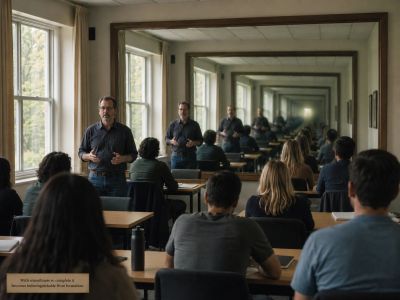
XI. The Smooth Monoculture
The AI age doesn’t just change what students learn.
It changes what kind of humans the education system produces.
The old system produced a mix: some Jaggeds, some Smooths.
The new system is producing fewer Jaggeds.
Because Jaggedness requires friction. And AI removes friction systematically.
Students who would have become Jagged in the old system — who had a natural tolerance for uncertainty and enjoyed struggle — are being optimized into Smooths because the system punishes friction and rewards completion.
And AI makes completion instant.
Friction and Formation
So how is AI changing human development?
The Five Prerequisites
Jaggedness requires exposure to friction. The current formation environment removes it.
Jaggedness requires practice in tolerating uncertainty. AI resolves uncertainty before tolerance can develop.
Jaggedness requires experience of being wrong. AI-assisted work rarely produces visible failure.
Jaggedness requires modeling from Jagged adults. Teachers entering classrooms now are increasingly Smooth themselves.
Jaggedness requires rewards for friction tolerance. The system rewards completion and penalizes the struggle that builds capacity.
AI-saturated education reduces exposure to all five prerequisites simultaneously.
The result isn’t the elimination of Jaggedness as a human capacity. It’s the elimination of the formation conditions that produce it. Humans remain capable of Jaggedness. The environment has stopped requiring it.
The Democratic Consequence
This matters beyond education.
Democracy requires citizens who can tolerate unresolved facts, hold contradictions without collapsing, and detect when institutions are drifting from their mandates.
Those are Jagged capacities.
They aren’t exotic civic virtues. They’re the operational baseline for self-governance. A citizen who cannot hold unresolved tension cannot evaluate competing claims. Cannot sit with “I don’t know yet.” Cannot maintain skepticism toward institutions that sound fluent and coherent.
Smoothness is not politically neutral. A population optimized for frictionless coherence prefers resolution over accuracy. That’s not a character flaw. It’s a formation outcome.
And it’s not being built against.
The Loop
Here’s where the structure completes itself.
AI-saturated education produces Smooths. Smooths enter media as anchors, producers, and audiences. Media optimizes for Smooth delivery because Smooth audiences have diminishing tolerance for friction, which trains more Smooths, who enter education as teachers, who produce more Smooths.
The system doesn’t require a conspiracy to lock. It requires only that each actor respond rationally to the incentives before them.
And it locks anyway.
This is how Smoothness becomes the dominant formation outcome.
Not through force. Not through design.
Through optimization.
The Real Danger
A society can survive bad information. Yellow journalism, propaganda, deliberate disinformation — these are problems with a long history and known mechanisms of resistance.
But those mechanisms of resistance are Jagged capacities. The ability to sit with uncomfortable facts. To hold contradictory evidence. To resist the pull of coherent narratives that feel resolved.
The danger isn’t primarily that AI produces false information.
The danger is that AI makes information feel prematurely resolved.
Truth is slow, incomplete, and always in the process of revising itself. It asks you to live with tension that never fully closes. After sustained exposure to frictionless AI systems, that tension starts to feel like a malfunction — a sign the system is broken — rather than a feature of how reality actually works.
That’s the formation shift that doesn’t show up in test scores.
AI won’t damage education by making it dishonest. It will damage it by making it too coherent.
That is how education becomes completion delivery. That is how the conditions for Jaggedness stop being produced. That is how a society generates credentials without the capacity those credentials were built to represent.
Not with malice. Not with conspiracy.
With smoothness so complete it becomes indistinguishable from formation.

Where the Full Evidence Lives
Everything on this page is an argument built from classrooms, exam halls, and hiring data. Two companion pieces on Thinking Sovereignty do the deeper evidentiary work behind it.
Does AI Affect How Children Learn to Think? is the fuller record, drawn from controlled studies, company disclosures, and Jeannine's own testimony, on what AI does to a child's formation specifically, the question this page raises but doesn't fully carry.
The Window of Formation makes the sharper, narrower claim underneath all of it: that timing matters as much as exposure, and that the same assistance which builds capacity before independent mastery can quietly replace it after.
If this page convinced you something is happening, those two are where you go to see exactly how much of it can be proven.