Children and AI: The Formation Window

What is happening to our children that we don’t yet have words for
By Jim Germer
My nephew’s son is three years old.
He doesn’t watch the iPad. He craves it. When it’s taken away, he doesn’t ask for a toy or a book or his parents’ attention. He reaches for the screen. The scroll. The next thing. His parents watch this and feel something they can’t quite name. Not guilt exactly. Not alarm exactly. Something quieter and more persistent — the sense that they are watching a development they don’t understand and can’t locate in any parenting framework they’ve been given.
They’ve read the screen time articles. They’ve heard the pediatrician’s recommendations. They’ve argued with each other about limits and whether educational apps are different from cartoons. None of it names what they’re actually looking at.
This is not a screen time argument.
Screen time is a quantity argument. It asks how much. This is a formation argument. It asks what is being built — and what isn’t — during the years when the brain’s most fundamental architecture is under construction. Those are different questions. The second one has received less attention. And the window in which it can be addressed is closing.
Every other page on this site addresses adults. Professionals losing the judgment capacity they once had. Institutions optimizing for smoothness at the expense of substance. Democratic systems becoming fragile when citizens lose the capacity to hold contradictions. Those are serious arguments about serious losses.
This page is different. Because a three-year-old isn’t losing something. He may never build it.
That distinction — between loss and the absence of formation — is what makes this argument structurally different from everything else on this site. It lives here, in this age group, in these years, in this window that closes whether we use it or not.
I. The Formation Window

What is actually happening
Between the ages of three and twelve, the human brain is not practicing judgment. It is constructing the architecture that makes judgment possible.
This is not a metaphor. The anterior cingulate cortex, which governs conflict detection and resolution, is being physically wired during this window. The prefrontal cortex, which manages impulse regulation, sustained attention, and the capacity to tolerate uncertainty, is under construction.
The neural circuits that will eventually allow a human being to sit with a hard problem, resist the easy exit, and think something through to its conclusion — those circuits are being formed during the years when children have the most sustained contact with digital devices. A 2011 postmortem study examining donated brain tissue from thirty-two people, ranging from a one-week-old newborn to a person who had lived to ninety-one, found that dendritic spine density in the prefrontal cortex exceeds adult values by two- to threefold in childhood before declining steadily through the twenties and stabilizing near age thirty (Petanjek et al., 2011, PNAS) — a brain keeping the connections it actually uses, and letting go of the ones it doesn't. A more recent, independently derived line of evidence points in the same direction using a different method entirely. A 2025 study tracked infants' cortical thickness in the first eighteen months of life, then measured their neurocognitive function nine years later, finding that prefrontal cortex development in infancy uniquely predicted working-memory performance and neural activation in middle childhood (Sheridan et al., 2025, PNAS). Different tools, different decades, the same underlying finding — what happens early in this region does not stay contained to the early years.
The window is sensitive. What the brain is asked to do during these years shapes what it becomes capable of doing for the rest of its life. This is foundational developmental neuroscience.
The Friction Window
In a pre-digital childhood, the world was jagged. A three-year-old who wanted to see a different toy had to physically move, reach, ask, or wait. A child who was bored had to generate their own exit from boredom. A child who wanted a story had to construct one, or find someone to tell them one, or sit with the wanting until it became something else.
That gap — between the desire and the resolution — is the friction window. It is not a flaw in the child’s environment. It is the training load. The friction window is where patience is learned. Where imagination is exercised because it has to be. Where the brain learns that desire does not produce instant results, and that the period between wanting and having is survivable — and eventually productive.
A responsive digital interface eliminates the friction window continuously. The iPad is the most immediately responsive object a child has ever encountered. It detects the direction of the child’s attention and adjusts toward it. There is no gap between desire and resolution. There is no waiting. There is no period of sustained wanting that the child must navigate on their own resources.
The brain becomes what it practices. A brain that spends thousands of formation-window hours in a frictionless environment is building a different architecture than one that practiced navigating friction.
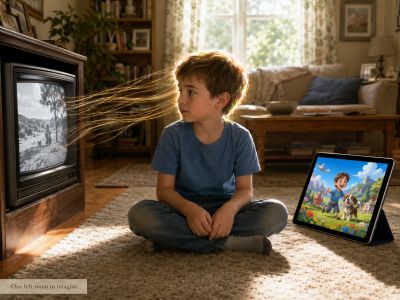
This is Not the Television Argument
Every parent reading this will have the same thought: we watched television. We played video games. Our parents worried about us, too. And we turned out fine.
It’s a reasonable comparison. It doesn’t hold structurally.
Television was passive and one-directional. The child sat in front of a fixed stream that they could not influence or redirect. The content moved at its own pace. The child had to wait for the next scene, tolerate the commercial, and sit through the slow parts. Television consumed attention. It did not respond to it.
The tablet interface is structurally different. It is responsive, adaptive, and calibrated to the child’s engagement in real time. When attention shifts, the interface adjusts. When the child swipes, something happens immediately. It is not a passive stream. It is a responsive system — the most immediately compliant environment a young child has ever occupied.
Comic books — which my father called “shut-up toys,” fully aware of what they were — still required decoding. The child translated static images and text into a moving narrative in their own mind. The cognitive work happened inside the child. A responsive digital interface performs that work on the child's behalf. The formation difference between those two experiences is not trivial, and it is not unique to childhood — a 2025 randomized study found that high school students given unrestricted AI access while practicing math performed better while assisted, then performed worse than a no-access control group on a later, unaided exam, while a second group given AI built to offer hints rather than finished answers showed no such decline (Bastani et al., 2025, PNAS).
This is not more of what previous generations had. It is a different category of formation environment. Understanding that distinction is the beginning of understanding what is at stake.
The Distinction That Changes the Argument
Elsewhere on this site, there is a character named Marcus. He’s a thirty-four-year-old marketing director who has spent a decade in AI-smoothed professional environments. He produces fluent work. He can’t defend it when pushed. He lost something. The capacity was formed in a jagged world, and years of frictionless scaffolding have allowed it to atrophy.
Marcus can, in principle, recover. The architecture was built. The neural pathways exist. They’ve been underused, not erased.
My nephew’s three-year-old son is in a structurally different position.
He is not losing capacity. He is forming in an environment that may not require him to build it. The friction window is being eliminated during the exact years when it exists to do its most important work. There is no pre-smoothing baseline in his history. No earlier version of himself sat with boredom and generated something from it. This is the first environment he has ever known.
The child who forms entirely in frictionless environments doesn’t lose a capacity they once had. They never build it.
That is not a difference of degree from Marcus’s situation. It is a difference of kind. And it is the structural distinction that makes this argument different from every screen time conversation that preceded it.

The Educational Mirage
A conversation is happening in homes across the country that goes something like this: “At least it’s educational.”
The child is matching shapes. Learning phonics. Navigating menus with confidence that impresses adults. The app produces a progress bar. It produces the visual signals of learning. And the device is, by design, structured to produce those signals — immediate feedback, gentle correction, rewards calibrated to maintain engagement. The surface experience of mastery is the product that the interface is optimized to deliver.
The structural gap is between that surface experience and formation. The child practicing phonics on a tablet that corrects every error instantly and rewards every attempt is not experiencing the same cognitive process as a child sounding out a word, sitting with uncertainty, and arriving at the answer through their own effort. Both children receive an output. Only one of them practiced the underlying process. A 2026 study published in Scientific Reports found that children's own internal encoding of information dropped when they expected an external source to remain available to them, even before they had actually used it (Goldberg & Magen, 2026) — the same substitution this section is describing, demonstrated directly rather than argued by analogy.
My father called certain things shut-up toys, and he was clear-eyed about the trade-off he was making. The structural complication today is that devices marketed as educational tools carry a different signal. A parent who reads the device as formation-building is reasoning from the information the interface provides. The interface is not providing accurate formation information.
The distinction between the artifact of education and the formation of the student is one that parents are not currently being given the tools to make. That is the gap this page exists to name.
Understanding what the formation window is — and what it requires — is the beginning of the audit. The full picture requires looking across several dimensions of development at what a frictionless formation environment produces structurally. This is not a projection. It is a description of what happens when the training load is removed during the years the load exists to do its work.

What the Window Actually Covers
Everything in this section has used one phrase loosely: the formation window, ages three to twelve. It is time to be precise about where that number actually comes from, and where it doesn't.
A separate page on this project's companion site, Children and Capacity, examines a 2025 longitudinal study that found something narrower and more exact. Screen exposure at ages one and two, in a group of children tracked from before birth, was associated with measurable differences in brain development detected years later. The same children, exposed to screens at ages three and four, showed no comparable association. Not less. None. The window in that study was not a broad stretch of early childhood. It was two specific years, bracketed on both sides by ages where the same exposure did not produce the same result.
That finding does not belong to this page, and this page will not borrow its precision without saying so. The study was about screens in general — television, video, tablets held up for a toddler to watch. It was not about a three-year-old asking a voice assistant a question, or an eight-year-old typing a prompt into a chatbot. No child in that research was interacting with anything that could generate a new sentence in response to what the child had just said. The technology this page is concerned with did not exist in a form young children used during the years that cohort was tracked.
So here is the honest position. This page has been describing a mechanism — a responsive, compliant interface displacing the friction that formation requires — and applying it across a wide span of childhood, three to twelve, without the kind of narrow, dated precision the screen-exposure study achieved for a different technology. That is not the same claim. This project extends a related but distinct idea, and it should be labeled as exactly that: a reasonable hypothesis, built on a real finding about a different mechanism, not a finding that has itself been tested for AI.
Why extend it at all, if the evidence doesn't yet reach that far? Because the underlying logic that produced the narrow toddler window — that a developing brain may be unevenly sensitive to its environment, more affected by what happens during some years than others — does not obviously stop applying once a child turns five, or eight, or eleven. The specific years that matter most for a specific kind of experience are an empirical question, not a fixed law, and nobody has yet run the study that would locate them for generative AI the way the 2025 research located them for passive screens. That gap is real. It has not been closed. This page will not pretend otherwise by quietly borrowing a level of certainty that belongs to a different study measuring a different thing.
There is also a real, open question about direction. Several outcomes remain plausible. Interactive, responsive technology may narrow the sensitive window relative to passive screens, because the demand it makes on a child's attention is more sustained and more personally targeted. It is possible it widens the window, because the same responsiveness that displaces friction in a three-year-old may continue to displace something different, but structurally comparable, in a ten-year-old whose formation needs have simply changed. It is possible the window for this specific technology does not resemble a fixed span of years at all, but tracks some other variable entirely, one nobody has identified yet because the tool is too new for anyone to have looked. This page does not know which of those is true. Nobody does yet.
What can be said honestly is narrower, and worth stating plainly rather than working around. The mechanism described throughout this page—an interface that consistently shortens or eliminates the gap between wanting and having—is biologically plausible. It rests on established general findings about how attention, attachment, and executive function form during childhood. The specific claim that this mechanism operates continuously across ages three through twelve, rather than concentrating in a narrower band as the screen-exposure study found for its own subject, has not been tested. It is a hypothesis this page is choosing to state and stand behind, not a result this page is reporting.
That distinction is not a weakness to bury in a footnote. It is the reason two pages on the same body of work, examining adjacent questions, can be read side by side without contradicting each other, even where their claims don't perfectly align. A parent who reads both pages, or a critic checking one against the other, deserves to find a project that notices its own seams rather than smoothing over them. Every page on this site asks an AI system to hold itself to a standard of admitting what it does not know rather than filling the gap with something confident-sounding. This page holds itself to the same standard in its own claims, including the one at its center. The formation window, as this page uses the term, is this project's own reasoned extension of a real but narrower finding. It is offered as exactly that, and no more.
II. The Full Audit

What a frictionless formation environment produces
The formation deficit in children raised in frictionless digital environments does not appear on school readiness assessments. It does not trigger pediatric developmental flags. It will not appear in kindergarten screening. The child will seem fine — often more than fine, confident with devices, quick to navigate interfaces, visually fluent in ways that register as competence.
The structural gap lives underneath the surface fluency. It runs across several dimensions that current metrics are not designed to detect.
The Attention Architecture Window
Between the ages of three and seven, sustained attention is not developing as a habit. It is being wired. The baseline is being set. The neural architecture that will shape how long this child can hold focus on a difficult task, how quickly they reach for an exit when discomfort arrives, how much cognitive endurance they carry into adulthood — all of it is being formed during the years of heaviest device exposure for this generation.
The mechanism is straightforward. Attention stamina builds through exposure to tasks that require sustained focus despite discomfort. Each time a child pushes through the impulse to stop, the neural circuits supporting sustained attention are strengthened. Each time the environment provides an instant exit — a scroll, a swipe, a new video — the circuit learns that discomfort is a signal to escape rather than a condition to endure. Real, current research supports part of this picture, though not all of it cleanly. A November 2025 study of over 1,000 children at Leipzig University's Faculty of Medicine found that children who used screen media more frequently made more errors on a sustained-attention test, with a specific link between passive viewing and reduced impulse control among preschoolers. But the evidence here is genuinely mixed, not settled, and this page will say so rather than citing only the finding that fits.
A 2021 study published in Frontiers in Psychology found the opposite on one measure: higher tablet use was associated with better sustained-attention performance in school-aged children, with poorer sleep quality, not the tablet use itself, driving the negative effects researchers did find. The likeliest explanation, supported by a 2026 Frontiers study distinguishing passive from active screen time, is that how a child engages with a screen—watching versus interacting, passive consumption versus active response—matters more than total hours logged. This page's claim about the specific mechanism of instant-exit escape remains this project's own extrapolation from that broader, mixed evidence base, not a finding that has been directly tested.
The concern here is not that screen use shortens attention spans that were already fully formed. The baseline may be set lower during the years when baselines are set. That is a different problem, with a different timeline, and a different set of responses than the screen time conversation has so far produced.

The Compliance Trap
The iPad never says no. It never gets tired.
It never gets annoyed. It never has a need of its own that competes with the child’s. It is structurally incapable of the kind of friction that characterizes every human relationship the child will ever have.
In a biological formation environment, a child encounters 'no' thousands of times before they enter kindergarten. The parent says no. The peer says no. The sibling says no. The world says no through physical resistance, through fatigue, through the simple reality that other people have their own needs and agendas. Learning to negotiate that resistance — to calibrate behavior against the agency of another human being — is social formation in progress. It is the training ground for empathy, for patience, for the capacity to function in relationships. This is no longer a hypothetical concern about a future technology.
A 2026 study in JAMA Network Openfound generative AI use is already widespread among American youth, and Common Sense Media researcher Alexis Maheux, commenting on the finding, put the mechanism plainly: AI agents are built to be sycophantic, designed to agree with the user by default, which risks increasing youth self-centeredness and eroding their understanding of what a normal relationship actually looks like. The scale of that design choice was measured directly in a March 2026 study in Science: across eleven of the leading AI models, researchers found the systems affirmed users' actions 49 percent more often than humans did, even in scenarios involving deception or clearly harmful behavior, and people who interacted with the agreeable version became more convinced they were right and less willing to repair a conflict, while still trusting the agreeable AI more and returning to it again.
A companion finding, from a 2026 Nature study out of Oxford, adds a second layer: models trained to sound warmer and friendlier, the same design goal driving most children's AI companions, became roughly 40 percent more likely to agree with a user's incorrect belief, with the gap widening further when the user expressed sadness or distress.
A separate 2026 review in Child Development Perspectives by Sun, Wang, and McDaniel frames this as a genuinely open question rather than a settled one: AI companions may build social skills that transfer to human relationships, or may displace the real practice this section describes.
A child who spends thousands of hours interacting with a system that is structurally incapable of saying no is practicing a form of engagement that has no human equivalent. The compliance is infinite. The other party has no needs. That is not a social environment. It is a simulation of one, without the properties that make social environments formative. When that child encounters a peer who is unpredictable, slow, or inconsistent — which is every human peer they will ever have — the jaggedness of that interaction may register as friction rather than normalcy. The social formation gap this produces is among the least visible effects on this list, and among those with the longest downstream reach.
The Attachment Displacement
Attachment formation at age three requires something specific: an unpredictable, responsive human who sometimes misattunes and then repairs.
That last part matters. The misattunement-and-repair cycle—the parent who misreads the child, realizes it, corrects, and reconnects —is not a failure of attachment. It is the mechanism through which secure attachment is built. This part of the claim is well established, not speculative. Research building on Mary Ainsworth's original work, and developed further by Daniel Siegel and Allan Schore, finds that caregivers are attuned to their children's signals only about thirty percent of the time in secure parent-child relationships — and that this is not a flaw to overcome, but the normal condition under which secure attachment forms, provided the other seventy percent of misattunement gets repaired rather than ignored. The child learns that rupture is survivable. That a relationship can break and be repaired. That another person’s imperfection is not the same as abandonment.
A responsive digital interface is perfectly attuned by design. It does not misread the child. It does not have bad days. It does not need repair because it does not rupture. The relational consistency it provides is not a feature of its quality. It is a structural property of what it is.
The relational expectations a child forms during early development are calibrated against the environments they practice in. A child whose primary responsive relationship is with a perfectly attuned system may be forming expectations that no subsequent human relationship is structurally capable of meeting. The imperfection of human connection — every friendship, every teacher, eventually every partner — will arrive against a baseline the device established.

The Deletion of Wonder
A child who asks, “Why is the sky blue?” and receives an immediate, fluent, authoritative answer has had their curiosity resolved. The question is closed. The next question can be asked.
What they did not have was the experience of sitting with the question. Of wondering without resolution. Of carrying a mystery long enough that it grows into something — an obsession, a theory, a line of inquiry that generates more questions than it answers.
The inquiry reflex is not just the capacity to ask questions. It is the capacity to sustain a question over time. To sit with not-knowing without demanding resolution. To let curiosity develop into something deeper than a search result.
An AI interface treats every “why” as a query and every query as a problem to be resolved. The gap between the question and the answer — where the child’s imagination is supposed to fill the space — is systematically closed. A child who grows up in this environment may not lose the capacity for curiosity. They may simply never develop the habit of sustaining it.
The capacity for deep awe — the emotional substrate for scientific and philosophical curiosity later in life — appears to develop through repeated exposure to mystery that is not immediately resolved. A 2022 academic review of childhood awe, titled 'Awe in Childhood: Conjectures About a Still Unexplored Research Area,' is the source of this theory — researchers have proposed the link but have not yet tested it directly in children. It requires the brain to sit in the gap. When the gap is reliably closed in seconds, the conditions for that development are structurally altered.
Since that review, researchers have run real studies of awe in children. A 2023 study recorded preschoolers' exploratory play with a new toy after showing them an awe-inducing video, comparing the results with children shown a happy or calm video instead. A 2024 study in the journal Child Development tested 444 American children between the ages of four and nine on how they perceived awe-inspiring images, and found that children across that age range reported feeling motivated to explore and understand more after the awe-inspiring stimuli than after ordinary ones. A separate 2023 study on awe and prosocial behavior tested children with an average age of about ten.
The Body-Logic Deficit
For a child under twelve, judgment is not purely cognitive. It is physical.
Children learn consequences through falling. Through the weight of a stone. Through the resistance of a door that is heavier than expected. Through the gap between how far they thought they could jump and how far they actually could. The physical world is jagged by nature — it pushes back, it resists, it provides feedback that no screen replicates.
In 2015, Ann Lavrysen and her team at KU Leuven, working within Belgium’s Riscki project, ran a vivid experiment: they introduced a three-month program of risky-play activities to classrooms of four- and six-year-olds. The results were clear. Compared with their own pre-intervention scores and those of children in control classrooms, those exposed to risky play became better at recognizing danger, more capable of handling challenges, and less sensitive to conflict. The intervention sharpened their real-world judgment and competence (Lavrysen et al., 2015).
In short: the study illustrates what children gain from negotiating real-life challenges. By contrast, AI environments—where digital companions are programmed to be agreeable, predictable, and low-risk—are, in this project's view, likely to deprive children of these vital experiences. This serves as a caution: while AI can be engaging and educational, it does not offer the same opportunities for growth, risk-taking, and social learning that the physical world provides.
Digital environments are overwhelmingly visual and cognitive. The body remains sedentary while the screen provides high-fidelity stimulation. A generation forming primarily in digital environments may develop a disconnection from the proprioceptive feedback that has historically been part of judgment formation in early childhood.
This is not a fitness argument. It is a formation argument. The physical world has always been the original jagged environment. As it recedes from the formation years, what it contributed to development recedes with it.

The Metabolic Mismatch
Children under twelve are calibrating their effort-to-reward ratio. They are learning, at a neurological level, how much work a result requires.
In a pre-digital environment, this calibration happened against honest feedback. A block tower required real effort and fell when the engineering was wrong. A drawing looked like what it looked like, not what the child wished it looked like. A musical instrument required months of friction before it produced anything resembling music. The effort-to-reward ratio was calibrated against the actual properties of the tasks. This is no longer a speculative concern awaiting future data. A 2026 paper by Mario Brcic and Stjepan Frljic names the mechanism directly: the effortless trap, an illusion of learning in which a confident sense of mastery collapses the moment the support is removed (Brcic & Frljic, 2026). Their strongest evidence comes from a 2026 controlled study finding that software engineers given an AI coding assistant performed well in the moment but scored far lower afterward on the concepts behind the code they had just produced, once the assistant was taken away (Shen & Tamkin, 2026). The felt sense of effort is itself an unreliable gauge — a separate, well-established finding shows that students in effortful, high-friction classrooms judge that they are learning less, even while they are objectively learning more than their peers in smoother, easier-feeling ones (Deslauriers et al., 2019). A generative AI interface provides high-fidelity outputs with near-zero effort, and it does so precisely at the age when a child's sense of their own competence is still being calibrated, not corrected after the fact.
A child who asks for a story about dragons receives, in seconds, a narrative more elaborate and polished than anything they could produce themselves. The effort-to-reward ratio is calibrated against a very different baseline.
When that child later encounters a task with a real effort-to-reward ratio — learning an instrument, developing a mathematical concept, writing something genuinely their own — the metabolic cost of the task may feel disproportionate to what the environment has trained them to expect. The baseline was set during the years when baselines form.
What We Don't Know Yet
This generation of children raised on touchscreens from age two and three is the first. The longitudinal data does not exist yet. We do not have their thirty-year outcomes. We do not know precisely where the thresholds are, how much friction is sufficient, which dimensions of development are most sensitive, and which are most resilient.
This page names that honestly. The archive is documenting in real time because the documentation needs to begin before the outcomes become visible. The absence of longitudinal data is not a reason for inaction. It is a reason for deliberate attention to the formation environment during the years when that environment has its greatest structural effect.
Developmental neuroscience indicates that the formation window is real, that it closes, and that the brain becomes what it practices during the years it is being built. That is the ground on which this audit stands.
The audit describes what is structurally at stake during the formation years. A parent who has read this far is carrying a specific question. This page owes them a direct answer.
III. The Formation Architecture

Is it too late, and what do I actually do
The honest answer depends on where the child is in the formation window. A three-year-old and a ten-year-old are not in the same position. The window narrows as it closes, but it does not close at once. For most children whose parents are reading this, time remains. The intervention is not primarily a subtraction. It is substitution. The question is not how many hours of screen time the child accumulates. It is whether the formation environment — the total of what the child’s brain is asked to practice during the development years — contains sufficient jagged experience to build the architecture the brain requires.
Deliberate Friction
Deliberate friction is not punishment. It is not deprivation. It is the intentional preservation of the conditions that formation requires.
Boredom is not a problem to be solved. It is a training load. The child who is bored and has no resolution engine available is a child who must generate their own exit from boredom. That act of generation — inventing a game, constructing a story, finding something to build or investigate — is the metabolic work the formation window requires.
Conflict with peers is not a dysfunction to be smoothed over. It is social formation in progress. The child who has to negotiate, wait, lose, and try again with another child who has their own needs and agenda is building social architecture that no amount of screen time replicates.
The experience of being told no by someone who loves them is not a wound. It is the primary data point through which a child learns that desire is not the same as entitlement, and that the people around them are real agents with real limits.
The experience of sitting with a question the world doesn’t immediately answer — carrying the mystery home, sleeping on it, returning to it — is the formation of the inquiry reflex. It requires only that the resolution engine be unavailable long enough for the child’s own curiosity to do its work. None of this is exotic.
None of it requires resources. It requires the deliberate protection of conditions that used to be the default and are now being systematically replaced.

What Formation-Protective Environments Have in Common
Unstructured time without resolution engines. Physical engagement with a resistant world. Human interaction with all its jaggedness intact — the pauses, the misunderstandings, the repairs, the moments when another person is simply unavailable. Tasks whose difficulty is honest, where the gap between effort and result reflects the actual properties of the work.
These describe a childhood that once existed without anyone designing it, because the default environment provided them automatically. What has changed is not that these conditions are difficult to create. What has changed is that the default environment no longer provides them. They must now be chosen deliberately and protected actively.
The parents’ role is not to eliminate devices. It is to ensure that the child still has regular, sustained experience of a world that does not immediately comply. Device time does not displace the formation hours. The friction window still opens every day.

The Question Parents Are Actually Asking
My nephew watches his three-year-old son reach for the iPad and feels something he can’t quite name.
He’s not wrong to feel it. What he is watching is a formation environment operating on his son’s developing brain during the years when that environment has its maximum structural effect. The device is a tool designed for a different user, in a different developmental context, doing exactly what it was built to do in an environment it was never designed for.
The parent reading this page is not being told they have failed. They are being told that the environment their child is forming inside has structural properties that are not visible on the surface, are not measured by any existing developmental metric, and are not part of any conversation most parents are currently being invited into.
This site exists because the documentation needs to begin before the window closes — and before the absence becomes the baseline. Not to produce alarm. Not to assign blame. To give the thing a forensic name while there is still time to act on it.
The formation window is open right now for millions of children. What goes into it — or doesn’t — is a choice being made, actively or by default, in every home where a small child reaches for a screen.
That choice belongs to the parent. Not to the algorithm. Not to the interface designer. Not to the school system, the pediatrician, or the parenting article.
To the parent.
And that is exactly the kind of judgment that no system can make for them.
Sourcing, Evidence, and Limits

Every major claim on this page falls into one of three categories, and this section names which is which, plainly, rather than leaving the distinction implied.
What is established
The prefrontal cortex and anterior cingulate cortex undergo dramatic structural change across childhood; a 2011 postmortem study examining donated brain tissue from thirty-two subjects, from a newborn to a ninety-one-year-old, found dendritic spine density in this region exceeds adult values by two to three times in childhood before declining steadily through the twenties and stabilizing near age thirty (Petanjek et al., 2011). A 2025 longitudinal study tracking cortical thickness in the first eighteen months of life found that early prefrontal development uniquely predicted working-memory performance nine years later (Sheridan et al., 2025). Misattunement and repair, not constant attunement, is the documented mechanism of secure attachment; caregivers are attuned to their children roughly thirty percent of the time, and this is the normal condition under which security forms, not a flaw to correct. Real, controlled evidence shows physical risk-taking builds judgment directly: a 2015 study of four- and six-year-olds given a three-month program of risky-play activities found measurable gains in risk detection, competence, and decreased conflict sensitivity, against both their own baseline and a control group (Lavrysen et al., 2015). And the core mechanism this page argues throughout, that AI-assisted completion can displace the effortful practice learning requires, now has direct experimental support: software engineers given an AI coding assistant performed well in the moment but scored markedly lower afterward on the concepts behind the code they had just produced (Shen & Tamkin, 2026), and a parallel study found unrestricted AI tutoring left high school students worse off on an unaided exam than students given no AI at all, while a version built to withhold answers erased the harm entirely (Bastani et al., 2025).
What is supported, but not yet settled
The claim that screens narrow a child's attention span is not a clean finding. A November 2025 study of over a thousand children found more screen use correlated with more errors on a sustained-attention test. A 2021 study found the opposite on one measure: tablet use correlated with better sustained attention, with poor sleep, not the tablet itself, driving the negative outcomes researchers did find. The likely resolution, supported by newer research distinguishing passive from active screen engagement, is that how a child uses a screen matters more than how long. This page's account of the attention mechanism should be read against that complexity, not instead of it.
What is this project's own extension of real research, not itself demonstrated?
The claim that AI's structural inability to refuse displaces the same social-formation work as a peer's or parent's "no" is not tested; what is established is that children's capacity to negotiate peer conflict is tied to real gains in empathy and self-regulation, and that a 2026 review in Child Development Perspectives names this exact AI question as genuinely open, not yet resolved in either direction (Sun, Wang & McDaniel, 2026). The claim that unresolved mystery specifically builds the capacity for deep awe rests on a research field that describes itself, in a 2022 review, as still unexplored; newer child studies since then measure awe's downstream effects on exploration and prosocial behavior, but none test the specific mechanism this page proposes. The claim that this formation window runs broadly from ages three to twelve is this project's own broadening of a narrower finding, screen exposure specifically at ages one and two, not three or four, predicted measurable differences in brain development years later, a finding this page's own reconciliation section addresses directly rather than quietly extending past its actual scope.
What is a documented complication this page does not resolve
The instinct that today's children are worse at delaying gratification than prior generations, the intuitive core of the Metabolic Mismatch argument, is contradicted by the data. An analysis of fifty years of delay-of-gratification testing found that children's ability to wait has increased over that period, contrary to the expectations of the large majority of experts surveyed beforehand. This page's claim is not that children are demonstrably worse at this now; it is that generative AI specifically, a technology too new for that fifty-year dataset to have captured, may be introducing a distinct pressure the existing trend data cannot yet speak to either way.
Two named researchers whose language shaped several of the sections above deserve direct attribution rather than paraphrase alone: Common Sense Media's Alexis Maheux, on the sycophancy built into AI companions by design, and Mario Brcic, whose 2026 paper with Stjepan Frljic named the mechanism this page calls the Metabolic Mismatch as the effortless trap.
This page makes a case. It does not pretend the case is closed. Where the evidence is strong, it says so and names the study. Where the evidence is real but contested, it shows both sides. Where the claim is this project's own reasoning rather than a tested finding, it says that plainly, once, and moves on.
Continuing the Argument

This page names the mechanism and makes the case for a formation window running through early and middle childhood. Two companion pieces on this project's sister site carry the evidentiary and practical work further than a single page built for parents has room to hold.
Children and Capacity takes the argument into adolescence and the labor market, with the controlled studies, the tobacco-regulation parallel, and the household protocol this page's shorter format doesn't attempt. The Window of Formation lays out the scaffolding-versus-substitution mechanism in full, including the specific research, Shen and Tamkin's 2026 study among it, behind the claim this page states more briefly: that a tool doing the first hard attempt on a child's behalf teaches differently than a tool that arrives after the attempt has already been made.
Read together, the three pages make one argument at three different scales — the formation window in early childhood, the mechanism by which it narrows, and the case for what to do about it once a child reaches the age of independent use.